

This is part 12 of Crisis Money, a Money Outsider series about what financial crises do to our minds, and what our minds do back. It stands on its own, but part 11 covered narratives as epidemics.
Robert Shiller has argued that financial narratives spread through populations the way epidemics do. The psychoanalyst David Tuckett calls the investment stories that feel, to the person inside them, like a love affair "phantastic objects". This part is about who gets to tell those stories now.
The new storytellers
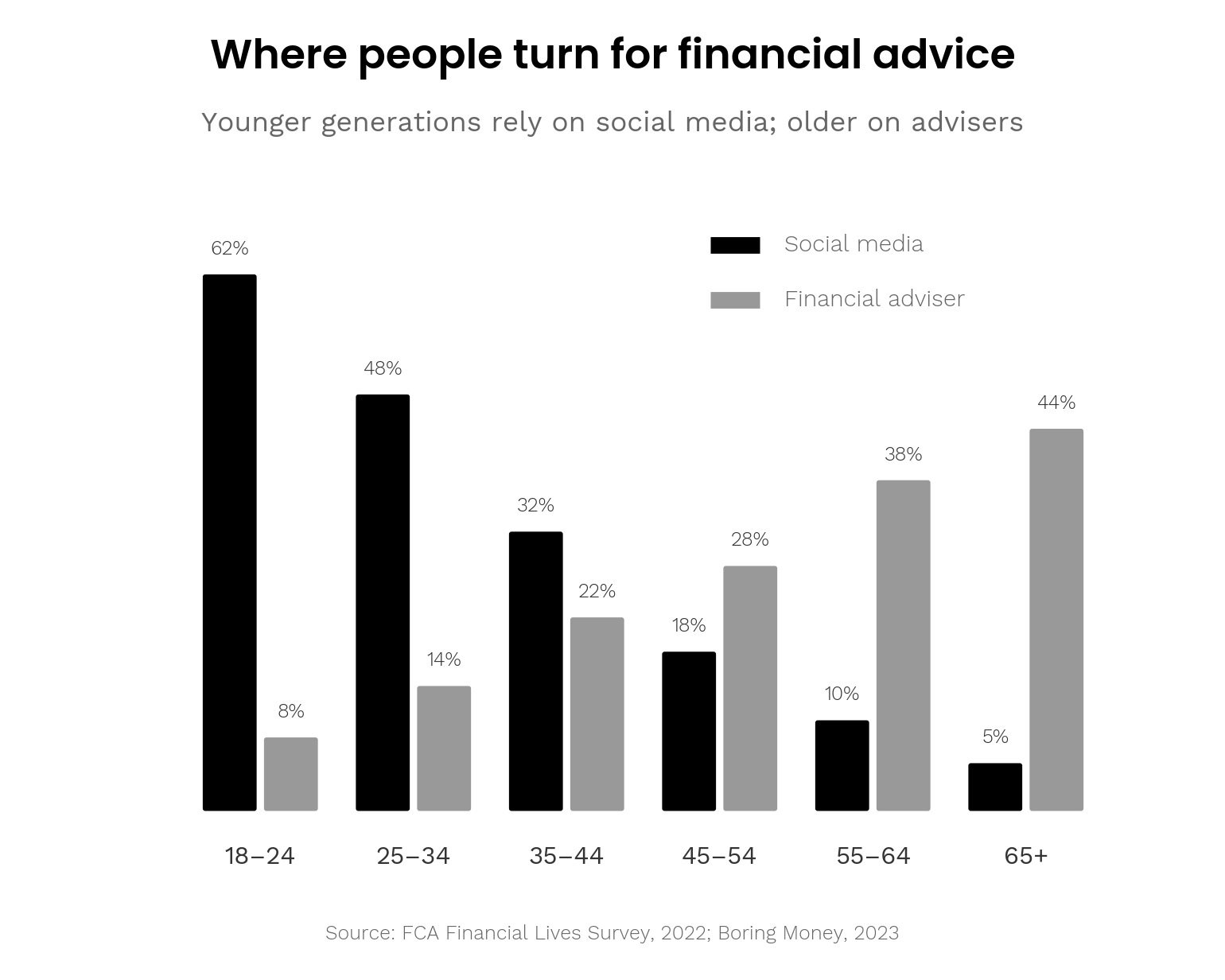
In 2023, Barclays published research on the influence of financial content creators on social media.1 The findings were striking. Four in ten young people were turning to social media for investment guidance. Among Generation Z, 46 per cent used TikTok specifically for financial advice. Just under half, 48 per cent, said they felt pressure to act quickly on social media advice, double the national average. And 42 per cent of those who had acted on social media investment content admitted to losing money as a result.
The trust figures were the most revealing. Among young followers of financial influencers, 74 per cent said they trusted the advice. More than half, 53 per cent, did not always verify the reliability of what they were told. And 58 per cent said they were more inclined to follow tips from influencers who appeared to have made a lot of money, which is to say, influencers who were themselves the most visible beneficiaries of the narrative they were promoting.
The FCA has recognised the problem, slowly. In March 2024, it published guidance on financial promotions via social media.2 In 2025, it led an international crackdown involving nine regulators. In the UK alone, the operation resulted in three arrests, criminal proceedings against three people, interviews with twenty finfluencers under caution, and fifty warning alerts.3 The FCA's own data showed that 62 per cent of 18-to-29-year-olds followed financial influencers, and that nine in ten of those followers said their financial behaviour had been influenced as a result.4
These numbers describe a structural shift in who tells financial stories and how those stories spread. A generation ago, the dominant financial narratives in Britain came from a small number of sources: broadsheet newspapers, television news, high-street bank branch managers, and financial advisers who were regulated and, in theory, accountable. The narratives could still be wrong, as the pre-2008 story about self-regulating markets demonstrated. But there was, at a minimum, a layer of institutional mediation between the story and the audience.
Instead of a broker in a suit, it's someone in a ring light.
That layer has largely disappeared for younger investors. A 22-year-old considering their first investment is more likely to encounter financial advice on TikTok than in a newspaper. The adviser they follow may have no qualifications, no regulatory oversight, and a direct financial incentive to promote whatever they're promoting. The narrative structure is identical to what Tuckett described: a phantastic object, a story about easy returns that dissolves uncertainty and makes the world feel simple. The delivery mechanism is different. Instead of a broker in a suit, it's someone in a ring light. But the psychological function, the creation of a narrative that makes risk feel manageable and doubt feel unnecessary, is exactly the same.
What makes this different from previous eras of bad financial advice is the incentive structure. A traditional financial adviser who gave bad advice faced regulatory consequences, complaints to the ombudsman, potential lawsuits. A finfluencer who promotes a failing investment faces no consequences at all, provided they include a small disclaimer that is never read. Their incentive is to produce content that gets engagement, which means content that is exciting, emotionally compelling, and action-oriented. The most effective finfluencer content creates exactly the kind of phantastic object that Tuckett described: a story about easy, inevitable returns that dissolves the anxiety of uncertainty. The regulatory gap is not just a technical problem. It is a psychological one.
The issue is not that all finfluencer content is bad. Some of it is genuinely useful, particularly basic financial education for people who receive almost none through formal channels. The issue is that the regulatory and institutional structures that used to (imperfectly) filter financial narratives have been bypassed. The FCA can fine a regulated firm for misleading promotions. It has much weaker tools for addressing the viral spread of unregulated financial stories through social media. Put plainly: the narrative infrastructure of modern finance is unregulated, and the people most vulnerable to compelling stories are those with the least experience to judge them by.
Sarah Hoff and Catherine Happer's research, published in Journalism in 2023, looked at how the cost-of-living crisis was framed in the UK press.5 Using keyphrase analysis drawing on Raymond Williams's concept of "keywords," they showed that the phrase "cost-of-living crisis" itself became a site of ideological struggle. The framing determined what was visible and what wasn't: energy company profits were covered differently from household budgets, government policy choices were presented as necessities rather than decisions, and the structural causes of rising costs received less attention than their immediate symptoms. The narrative shaped not just what people thought about the crisis, but what they thought the crisis was about. This is the key insight: narratives don't just distort information. They determine what counts as information in the first place. When the story is about household budgets, the relevant facts are food prices and energy bills. When the story is about corporate pricing power and energy market design, the relevant facts are profit margins and regulatory failures. Same crisis. Different narrative. Different facts. Different responses.
I think about Annamaria Lusardi's research on financial literacy here. Lusardi, who has spent decades studying how people understand money, has consistently found that knowledge alone is insufficient.6 People who score well on financial literacy tests still make decisions that look irrational from the outside, because decisions are made inside narrative frameworks, not outside them. Lusardi's more recent work, including studies at Stanford, suggests that combining factual financial knowledge with narrative and psychological self-awareness is more effective than either alone. People need to understand compound interest, yes. But they also need to understand why the story they're being told feels so compelling, and who benefits from their believing it.
The story changes
There is a pattern in the narrative history of British financial crises that is worth naming plainly, even if it's uncomfortable.
When a crisis arrives, the initial narrative tends to be accurate. Banks caused the 2008 crash. The pandemic was not anyone's economic fault. The energy price spike of 2022 was driven by Russia's invasion of Ukraine and decades of insufficient investment in domestic energy. In the immediate aftermath, the public response matches the narrative: anger at banks, solidarity during lockdown, fury at energy companies.
Then the narrative shifts. And the shift follows a consistent direction: away from structural causes and toward individual responsibility. The 2008 crash becomes a story about people living beyond their means. The pandemic's economic aftermath becomes a story about workers not wanting to return to the office. The cost-of-living crisis becomes a story about household budgets and shopping habits, not about corporate pricing decisions or energy market design.
This is not a conspiracy. It doesn't require a secret meeting where powerful people decide to change the story. It happens because the people who benefit from the structural status quo have more access to media platforms, more resources for shaping public discourse, and more incentive to shift blame downward. Mullen's research showed this clearly: elite sources dominated the newspaper coverage, and the narrative reflected their perspective. The mechanism is not deliberate manipulation. It is the natural consequence of unequal access to the means of narrative production.
The cost of living crisis offered a particularly clear example. When energy prices rose sharply in 2022, the initial public reaction was directed at energy companies and, to some degree, at the government's failure to insulate the UK from global price shocks. But within months, the media narrative had fragmented. Coverage focused on how households could cut their bills: switching energy tariffs, eating less meat, turning the thermostat down. The framing implied that the crisis was something individuals needed to manage, not something the system had produced. Hoff and Happer's keyphrase analysis documented this shift: the phrase "cost-of-living crisis" simultaneously acknowledged systemic failure and directed attention toward individual coping.
I want to be careful not to overstate this. Media coverage of crises is not monolithic. There were journalists who consistently covered the structural dimensions of austerity and the cost-of-living crisis. There are editors who pushed against the prevailing narrative. The point is not that no one told the truth. The point is that the dominant narrative, the one that reached the most people and shaped the most behaviour, tended to follow the pattern: structural problem in, individual responsibility out.
And this matters for the psychology of financial crisis. When the dominant narrative says that a crisis is your problem to manage, rather than a systemic failure to address, it changes how people respond. Loss aversion hits differently when you believe the loss is your fault. Herding behaviour changes when the herd is being told to tighten its belt rather than demand structural change. The narrative doesn't just describe the crisis. It shapes the psychological experience of living through it.
This is why the narrative chapters of financial crises matter so much, and why they receive so much less attention than the economic chapters. The economic story of austerity can be told in numbers: spending cuts, benefit freezes, local authority budgets reduced by 40 per cent. The narrative story is harder to quantify, but it shaped how people experienced those numbers. Did they feel angry at a system that was failing them, or ashamed of their own inability to cope? The dominant narrative pushed toward shame, and shame is one of the most economically destructive emotions a person can feel.
Consider the specific case of pension decisions during the 2022 market downturn. UK pension holders, many of them approaching retirement, watched the value of their defined-contribution pots fall as interest rates rose and equity markets dropped. The narrative available to them, from media coverage, from their pension platforms, from the general culture, was about individual financial responsibility: are you in the right fund, have you diversified properly, should you move to a safer allocation? The narrative that their pension design itself might be the problem, that a system in which individual retirees bear all the investment risk during market downturns is a policy choice rather than a law of nature, was much harder to find. The story shaped the response, and the response reinforced the story.
There's something else at work in the specific British context, something that connects the narrative question to herding behaviour. Britain has a particular cultural relationship with financial narratives: a tendency to adopt them late, hold them tightly, and abandon them violently. The property narrative is the clearest example. The story that house prices always rise became so embedded in British culture that it functioned less like an investment thesis and more like a national religion. When that narrative was threatened in 2008, the response was not proportionate adjustment but something closer to the grief that Tuckett described. And when the narrative reasserted itself, as it did within a few years of the crash, the relief was palpable. The story was back. Normal service had resumed. The possibility that the story itself was the problem was too uncomfortable to entertain.
What narratives cost
The financial cost of narrative contagion is measurable, at least in part. The Investment Association fund flow data shows £18.4 billion flowing into equity funds during the 2020-21 rally and £18.2 billion flowing out in 2022.7 Behind those numbers is a narrative: the rally narrative said stocks were going up and you'd be foolish to miss it; the crash narrative said get out while you still can. Each narrative was emotionally compelling and financially destructive.
But the deeper cost is harder to measure. It is the cost of living inside a story that tells you the problem is you.
When the austerity narrative became dominant after 2010, it didn't just change government policy. It changed how millions of people understood their own financial difficulties. If the story says that the country needs to live within its means, then your individual struggle to pay rent or heat your home becomes a version of the same problem: you, too, need to live within your means. The structural causes, frozen wages, rising housing costs, cuts to public services, retreat into the background. What remains is a story about personal failure, and that story has psychological consequences.
The Money and Mental Health Policy Institute found in 2016, in the largest study of its kind with roughly 5,500 respondents, that 93 per cent of people with mental health conditions spent more when they were unwell, and 92 per cent found financial decisions harder.8 Seventy-four per cent delayed paying bills. Seventy-one per cent avoided creditors. These are not signs of irresponsibility. They are symptoms of a feedback loop in which financial stress worsens mental health, and worsened mental health impairs financial decision-making. The narrative of individual responsibility obscures this loop, because acknowledging it would require acknowledging that the system, not the person, needs to change.
The Trussell Trust reported that in the 2023-24 financial year, it distributed a record 3.12 million emergency food parcels, of which 1.14 million went to children.9 StepChange, the debt charity, reported in 2024 that over half of their clients had waited more than a year before seeking help.10 Sixty per cent were in employment. Twenty-seven per cent were single parents, a group that makes up only 7 per cent of the UK population but is four times overrepresented among people in serious financial difficulty. These numbers don't describe individual failure. They describe a system producing predictable outcomes that the dominant narrative insists on framing as personal problems. And the narrative matters because it determines policy. If the story says that food bank usage is caused by poor household budgeting, the policy response is financial education. If the story says that food bank usage is caused by benefit levels being too low to live on, the policy response is different. The narrative isn't neutral. It has consequences.
Peter Butterworth and colleagues showed in a 2012 study in the journal Social Cognitive and Affective Neuroscience that financial hardship was associated with smaller hippocampal and amygdalar volumes, brain structures involved in memory and emotional processing.11 The study examined 431 middle-aged adults using structural MRI. This is not a metaphor for financial stress damaging the brain. It is a literal, measurable observation. Chronic financial hardship corresponds to structural differences in the brain regions that govern how people process risk, remember past experiences, and regulate emotional responses to threats. The narrative that says "make better decisions" is being directed at people whose capacity for decision-making has been physically affected by the conditions the narrative ignores.
I keep returning to a question that Tuckett's work raises by implication, even if he doesn't ask it directly. If investors form phantastic object relationships with investments, treating them as sources of psychological safety rather than financial instruments, do ordinary people form similar relationships with economic narratives? Do they hold onto the story that the economy is fundamentally fair, that hard work leads to security, that the system works, in the same way that a dot-com investor held onto a failing stock? Because if they do, then the shattering of that narrative during a crisis is not just an intellectual adjustment. It is a psychological loss, as real and as painful as the financial loss that accompanies it. And the people promoting a new, misleading narrative (austerity as household budgeting, the cost-of-living crisis as a personal responsibility) are not just distorting the facts. They are offering a replacement phantastic object, a simpler story that makes the world feel manageable again, even if the story is wrong.
What this means
Financial narratives are not an optional layer on top of economic reality. They are part of the reality. They determine which risks people notice and which they ignore. They determine whether a crisis feels like a shared problem or a personal failure. They determine, in the end, how much pain people are willing to endure and who they blame when things go wrong.
The regulatory system treats narratives as outside its scope. The FCA regulates individual claims, specific promises, measurable misleading statements. It does not regulate the background narrative that tells young people crypto is a path to wealth, or the dominant media framing that turns structural economic problems into stories about individual budgeting. The tools don't exist, and even if they did, regulating stories would raise obvious questions about free speech and state control of information. I don't have an easy answer to this. I'm not sure there is one.
But I think the first step is to stop pretending that narratives are separate from economics. Every part of this series deals with a psychological mechanism, loss aversion, herding, cognitive load, shame, that the current system treats as an individual problem. The narratives that surround those mechanisms determine whether they cause personal distress or collective action, whether they produce atomised anxiety or shared political demands for change.
Shiller was right that narratives spread like epidemics. But epidemics don't happen in a vacuum. They happen in populations with specific vulnerabilities, in environments that enable transmission, and they affect some people far more severely than others. Financial narratives spread fastest among people with the least information and the fewest institutional protections. They are amplified by platforms with no accountability and consumed by people with no training in evaluating them. The information asymmetry that Tuckett described between fund managers and markets has a parallel between ordinary people and the narratives about money that saturate their lives.
Newton lost a fortune in the South Sea Bubble because he fell in love with a story. Three hundred years later, millions of people are still falling in love with stories about money, property, crypto, the promise that the economy works for everyone, the promise that austerity is just belt-tightening. Some of these stories are told by finfluencers in ring lights. Some are told by prime ministers at dispatch boxes. The delivery mechanism varies. The psychological function is the same: a phantastic object, a story that makes the uncertain feel certain and the risky feel safe. Understanding this, truly understanding it, is the first step toward building an economy that doesn't depend on people believing in fairy tales.
But understanding is not enough on its own.
David Tuckett's fund managers, the ones he interviewed in 2006, did not think they were in the grip of a story. They thought they were making rational decisions based on available evidence. The phantastic object does not announce itself. It feels like clear thinking. It feels like confidence. It feels, as Tuckett described, like being in love. That is what makes financial narratives so dangerous, and so resistant to correction. You cannot argue someone out of a love affair. You can only wait for the loss that follows, and hope that next time, they recognise the feeling for what it is.
The stories are only half of the problem, because believing a bad story takes so little effort and checking it takes so much. In the next part, what scarcity does to the thinking mind, and why the people with the least money end up paying a cognitive tax on top of everything else. More soon.
Next in this series: The bandwidth tax. If this was useful, subscribing gets you the rest of the series as it lands.
Barclays (2023) Finfluencer Trust Survey. 46% of Gen Z used TikTok for financial advice; 42% reported losing money following finfluencer tips.
FCA (2024) Guidance on Financial Promotions on Social Media, March 2024.
FCA (2025) International Finfluencer Crackdown. Nine regulators coordinated; 3 UK arrests; 20 finfluencers interviewed under caution; 50 warning alerts issued.
FCA / Barclays (2023) research. 62% of 18-29 year-olds follow financial influencers on social media.
Hoff, S. & Happer, C. (2023) Keywords of cost-of-living crisis. Journalism, 24(11).
Lusardi, A. & Tufano, P. (2015) Debt literacy, financial experiences, and overindebtedness. Journal of Pension Economics and Finance, 14(4), pp. 332-368.
Investment Association (2022) Fund flow data. GBP 18.4 billion equity inflows 2020-21; GBP 18.2 billion outflows 2022.
Money and Mental Health Policy Institute (2016) Money on Your Mind. 5,500 respondents; 93% spent more when unwell; 92% found decisions harder.
Trussell Trust (2024) End of Year Statistics 2023-24. 3.12 million emergency food parcels distributed; 1.14 million to children.
StepChange (2024) Statistics Yearbook. More than half of clients waited over a year before seeking debt advice.
Butterworth, P. et al. (2012) Financial hardship and brain structure. Social Cognitive and Affective Neuroscience, 7(5), pp. 563-568.