

This is part 10 of Crisis Money, a Money Outsider series about what financial crises do to our minds, and what our minds do back. It stands on its own, but part 9 covered the three layers of trust, and how inflation broke them.
And then, briefly, something different happened.
In March 2020, as the pandemic shut down the economy, the UK government announced the Coronavirus Job Retention Scheme. The state would pay 80 per cent of furloughed employees' wages, up to a cap of 2,500 pounds per month. The scale was staggering: 11.7 million individual jobs were furloughed through the scheme, involving 1.3 million employers, at a total cost of approximately 70 billion pounds. At its peak on 8 May 2020, 8.9 million jobs were being supported simultaneously.1 Nearly a third of the UK workforce was, temporarily, on the government payroll.
The initial public response looked remarkably like the wartime rationing response. Approval was high. People accepted the arrangement because it met the criteria that the fairness instinct demands: a collective threat, a universal response, a sense that the burden was being shared. The threat was visible, the virus was killing people on the evening news. The response was universal, applying to workers across industries and income levels. And the sacrifice was perceived as shared. Everyone was locked down. Everyone was disrupted.
For a brief period, the social contract felt operational again. The government was doing what people believed governments should do in a crisis: protecting ordinary people from forces beyond their individual control. The contrast with the austerity response to 2008 was stark, and people noticed. The speed mattered too. Furlough was announced within days of the lockdown. There was no long period of debate about whether intervention was justified, no argument about moral hazard or market distortion. The government acted, and it acted for ordinary workers, and the psychological effect was immediate. People felt held.
But the fairness framework did not hold. As the months passed, a K-shaped recovery became visible. Asset prices rose sharply. People who owned property and investments saw their wealth increase during a pandemic. People on furlough at 80 per cent of salary, capped at 2,500 pounds, watched their savings erode. Key workers who could not work from home faced daily exposure to the virus while earning the same or less than those safely furloughed at home.
The executive pay data made the fracture explicit. Research from the High Pay Centre found that CEOs at FTSE 100 companies which had used the furlough scheme to pay their workers received significantly higher increases in total pay than those at companies that had not used furlough. Bonus pay in 2021 and 2022 at furlough-using companies ran 51 per cent higher than pre-pandemic levels.2 The CEO-to-worker pay ratio, which had already been climbing, reached 118 to 1 by 2022, up from 79 to 1 in 2020.3 Public money designed to protect workers' incomes was flowing through companies that simultaneously rewarded their executives at record levels.
HMRC's own evaluation found that fraud in the furlough scheme ran somewhere between 3 and 7.8 per cent of total spend.4 Billions of pounds claimed by businesses that did not qualify, or that continued to require furloughed employees to work. The enforcement that had maintained the wartime fairness compact, the visible prosecution of black marketeers, had no equivalent in the furlough system. The fraud was discovered after the fact, and much of it was never recovered.
Compare the furlough experience with the wartime rationing experience and the difference is instructive. Both involved massive state intervention during a crisis. Both had broad initial public support. But rationing maintained its fairness framework for fourteen years through constant enforcement and visible equality. Furlough lost its fairness framework within months because the inequality of the recovery was too obvious to ignore.
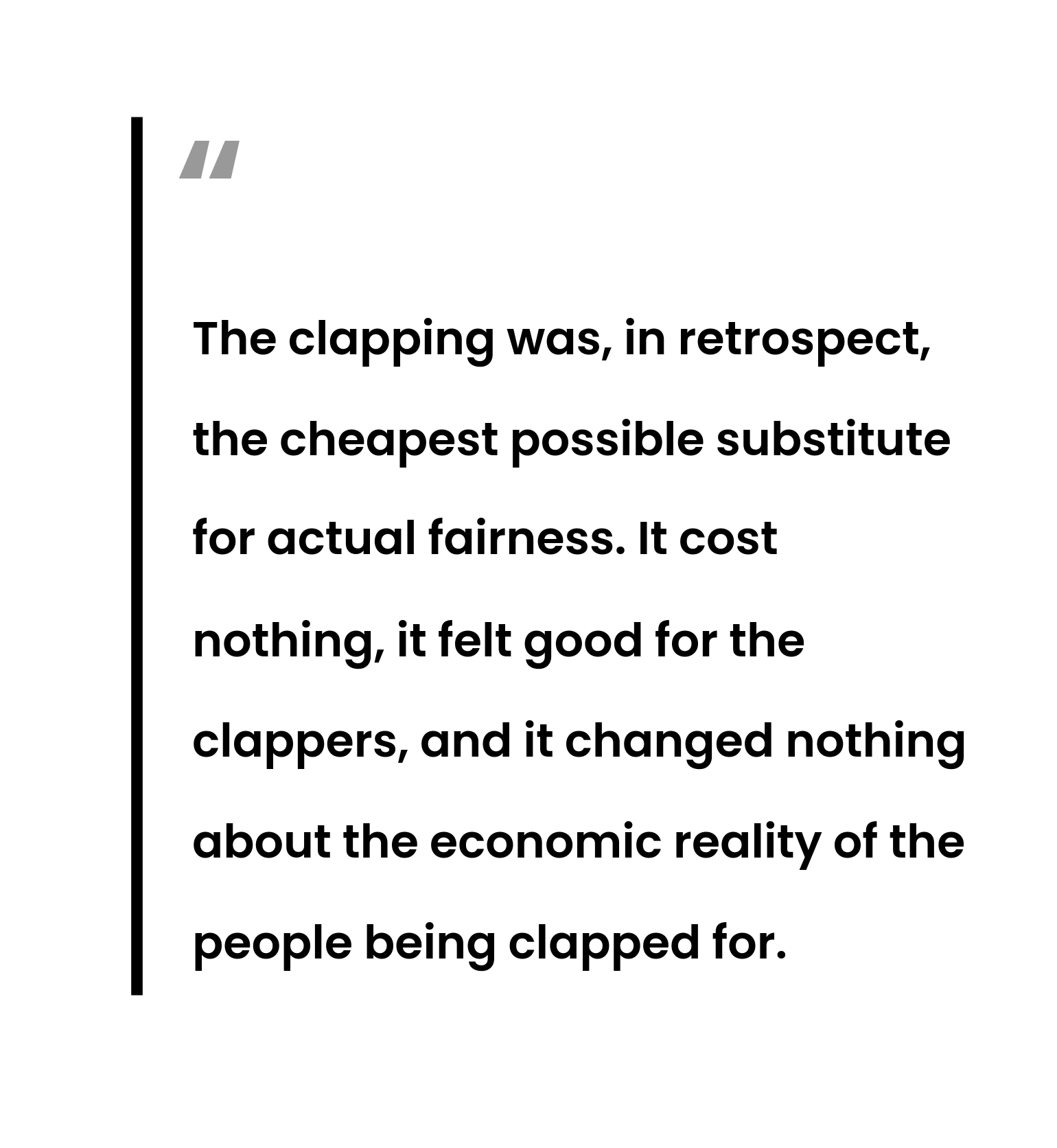
It is not enough for a policy to be fair at launch. The perception of fairness has to be maintained over time.
The furlough scheme reveals something important about how the fairness instinct works in practice. It is not enough for a policy to be fair at launch. The perception of fairness has to be maintained over time. The scheme began as a collective sacrifice, perceived as roughly equal. It ended as yet another episode in which public money flowed upwards while ordinary people absorbed the costs. The trust that was briefly restored by the initial response was eroded by the unequal recovery that followed.
What this means for you
The research across this part and the last points in a single direction. Your psychological response to financial hardship, whether caused by recession, inflation, benefit cuts, or a pandemic, depends less on the hardship itself than on whether the sacrifice feels fair.
Britons accepted strict rationing for fourteen years because the system was visibly equal. They rebelled against austerity that was objectively less severe because the burden fell on those who had not caused the problem. They supported furlough initially because it felt like shared sacrifice, then soured on it as the K-shaped recovery revealed that the sharing was an illusion.
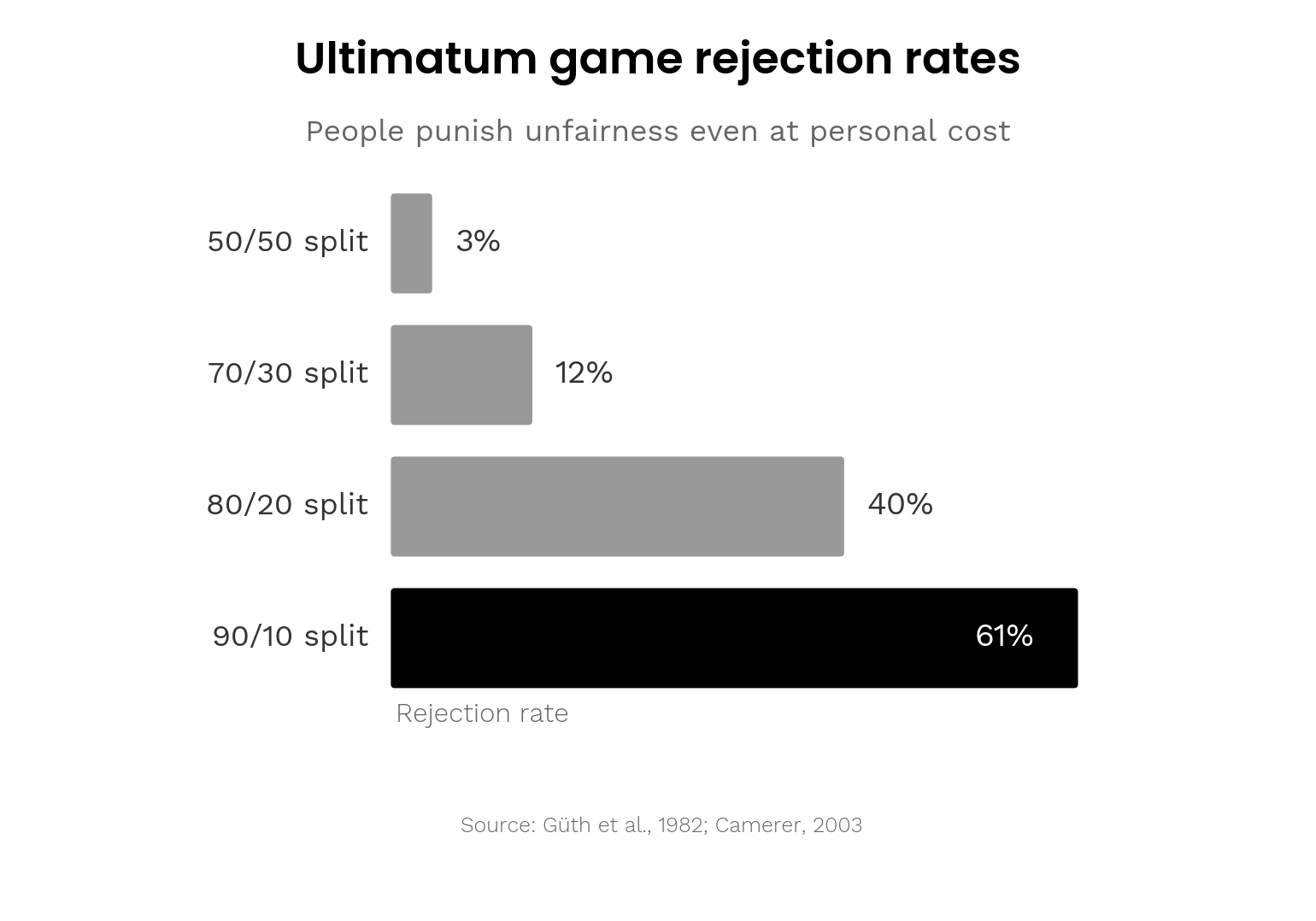
The ultimatum game shows this is not simply a political preference. It is a measurable feature of human psychology. People will accept a worse outcome for themselves rather than tolerate a distribution they consider unfair. Fehr and Schmidt's model quantifies it. Cross-cultural research confirms it exists everywhere, calibrated differently in different societies but present in all of them.
This has practical implications for how you process financial crises. When a recession hits, when inflation spikes, when the government announces spending cuts, your brain is not simply calculating your personal loss. It is running a fairness assessment. Who caused this? Who is paying for it? Is the burden falling equally? And that assessment, often made quickly and emotionally rather than through careful analysis, will determine your psychological response more than the actual numbers on your bank statement.
Understanding this about yourself is the first step to managing it. When you feel disproportionately angry about a financial setback, it is worth asking whether the anger is really about the money or about the fairness. Often it is both, tangled together in ways that make the financial problem harder to solve because the emotional problem is absorbing all your cognitive energy. Separating the fairness grievance from the practical financial question does not make either one go away, but it lets you address them independently instead of letting one paralyse the other.
If the answers feel wrong, the psychological damage is multiplied far beyond what the objective numbers would predict. The research on austerity's impact on single mothers, the Edelman data on income-stratified trust, Wu's finding that inflation erodes trust in ways that do not reverse: all of it confirms that unfairness is not just morally offensive. It is psychologically destructive in ways that persist for years, sometimes generations.
The policy implication is uncomfortable for anyone trained in conventional economics. Crisis policy is typically designed by people who model human beings as self-interest maximisers. If the policy produces the best aggregate outcome, it is considered successful. But the evidence from eight decades of British financial crises says otherwise. A policy that produces moderate hardship distributed fairly will generate less psychological damage, less political instability, and less long-term institutional erosion than a policy that produces less total hardship distributed unfairly.
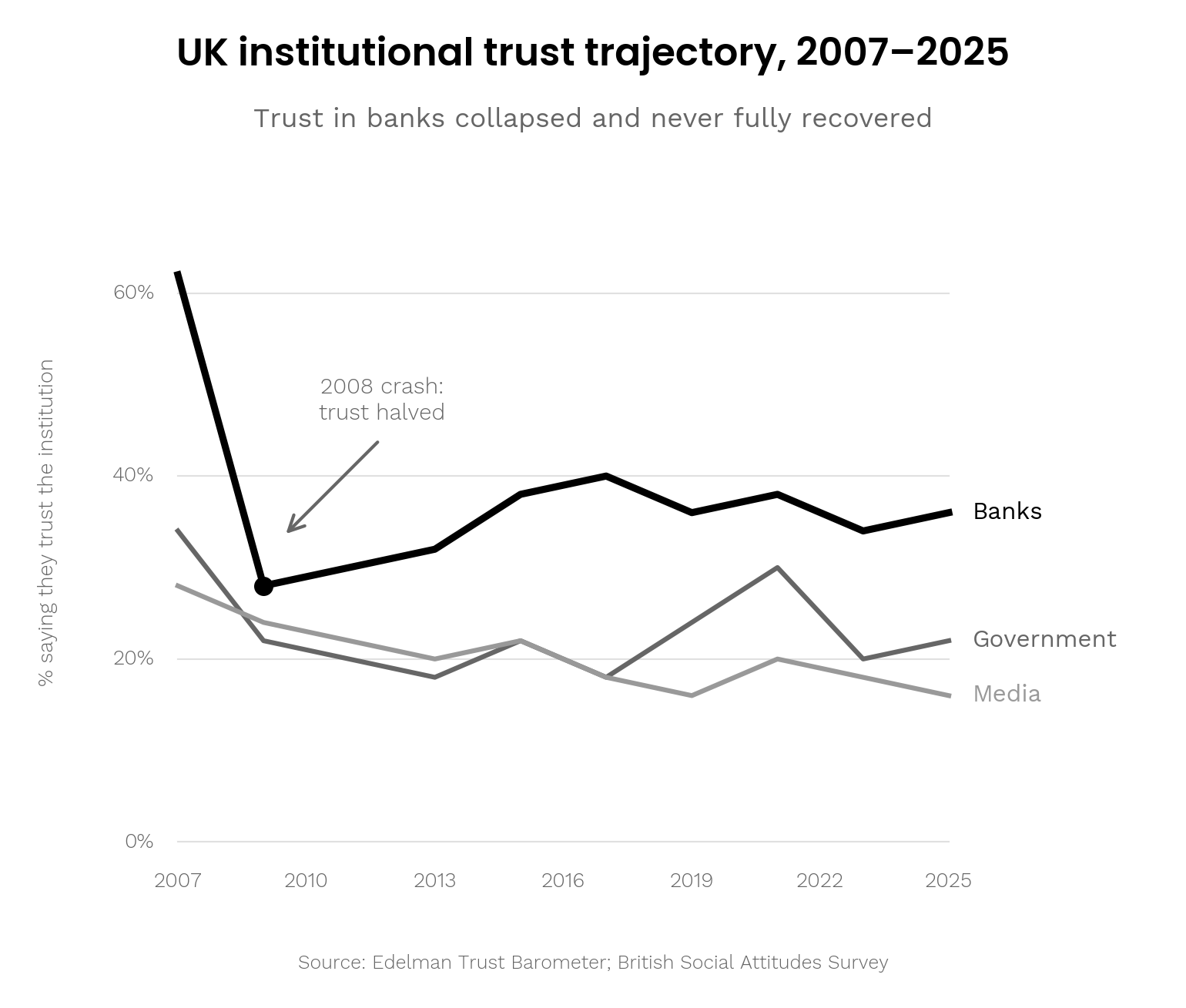
There is something I find personally unsettling about the cumulative picture these two parts have painted. We have a population that was asked to bail out the banks, then asked to accept austerity to pay for the bailout, then hit by inflation that eroded whatever savings they had left, then offered a furlough scheme that briefly felt fair before revealing itself as another mechanism for upward wealth transfer. Each episode on its own might have been absorbed. The sequence, taken together, represents a systematic dismantling of the belief that the economic system operates in the interests of ordinary people.
The dinner-party version of all this is straightforward. Next time someone tells you that the public just needs to accept tough economic medicine, ask them one question: who is taking it?
That institutional memory crossed borders. When the European Central Bank was established in 1998, its mandate was shaped more by German inflation trauma than by the economic conditions of the eurozone it would govern. The ECB's singular focus on price stability, modelled on the Bundesbank, reflected a specific national experience generalised into continental policy. During the eurozone debt crisis of 2010 to 2015, the ECB's reluctance to act as lender of last resort, its insistence on fiscal discipline as a precondition for support, can be read as institutional PTSD: an entire monetary system still flinching from a trauma that occurred a century earlier. The psychology of the Weimar collapse did not just shape German savers. It shaped the architecture of European monetary governance, with consequences that citizens of Greece, Spain, Portugal and Ireland experienced as austerity imposed from Frankfurt.
In 1940, the British government asked every adult to accept one egg per week. The sacrifice was real and the deprivation was genuine. But the ration book did not ask how much you earned. A duke and a docker got the same allocation of cheese. That visible equality was what made the system work. Eighty-five years and several financial crises later, the question is not whether people will accept sacrifice. They will. The question is whether anyone in a position of power is willing to design a sacrifice that looks anything like fair.
The deal is unwritten, but your brain enforces it anyway, and it keeps score for a long time. In the next part I turn to the stories we tell about financial crises, including the narrative that ate Britain, and why a good story moves an economy as surely as an interest rate does. Thanks for reading.
Next in this series: How stories drive economies. If this was useful, subscribing gets you the rest of the series as it lands.
House of Commons Library / GOV.UK (2020-2021) CJRS Statistics. 11.7 million jobs furloughed; 1.3 million employers participated; total cost approximately £70 billion; peak of 8.9 million on 8 May 2020.
High Pay Centre / TUC analysis (2021) CEO Pay and Furlough Usage at FTSE 100 Companies. CEO bonus pay 51% higher than pre-pandemic in 2021-22.
High Pay Centre (2024) CEO pay analysis. Ratio reached 118:1 in 2022, up from 79:1 in 2020.
HMRC (2023) 'The Coronavirus Job Retention Scheme (CJRS) Final Evaluation', July 2023. Error and fraud estimated at 3.0-7.8% of total spend (most likely 5.1%, approximately £3.5 billion). Billions claimed by businesses that did not qualify or continued to require furloughed employees to work.