

This is part 1 of Crisis Money, a Money Outsider series about what financial crises do to our minds, and what our minds do back. New parts land weekly.
On the morning of Friday 14 September 2007, a queue formed outside the Northern Rock branch in Kingston upon Thames. It was the first run on a British bank in a hundred and fifty years. By the time BBC camera crews arrived, the line stretched along the pavement and around the corner. Similar scenes were playing out at Northern Rock branches across the north-east of England and beyond: in Golders Green, in central Newcastle, in small towns where the building society had been a fixture of the high street for decades.
The people in those queues were mostly older. They had saved carefully, in many cases for decades. They were not speculators or traders, instead they were retired teachers, former factory workers and couples who had put their life savings into an institution they trusted because of its building society heritage and physical branch network. Some brought folding chairs. Some brought flasks of tea.

Barbara Williams, a retired depositor, told reporters:
"I didn't initially panic but the more you watch the news and read you think maybe we ought to do it as well. We thought we would do what everyone else is doing."
That sentence contains, in miniature, almost everything this series is about. The herd instinct. The role of media narratives. The contagion of financial fear. The gap between rational calculation and emotional response.
The images from that Friday went around the world. They looked like something from the 1930s. But they were misleading in an important way. Hyun Song Shin's analysis in the Journal of Economic Perspectives showed that the branch queues were partly an artefact of Northern Rock's business model.1 The bank had only 72 branches, most with just two counter positions. The physical queue was dramatic precisely because the infrastructure was small. The majority of Northern Rock withdrawals were actually made online and by telephone. Approximately one billion pounds left the bank on Friday and Saturday alone, and most of it vanished electronically, without anyone standing in line.
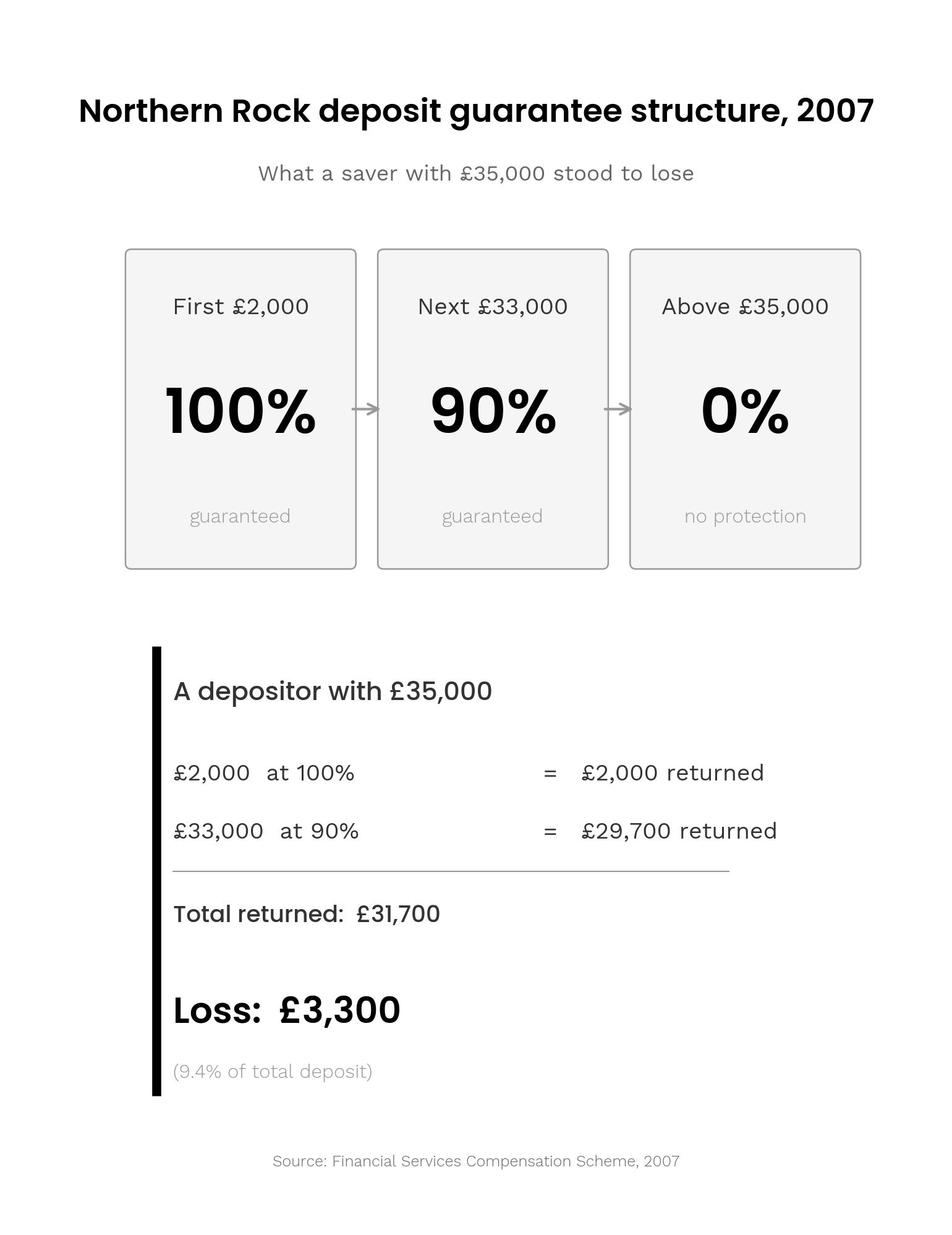
The depositors were not irrational. The UK's deposit insurance scheme at the time guaranteed 100 per cent of the first £2,000 and only 90 per cent of the next £33,000. Someone with £35,000 in Northern Rock stood to lose £3,300 if the bank failed. The Bank of England's Governor later confirmed that the depositors' behaviour was entirely rational given the legal framework. The queue was not a failure of public understanding. It was a perfectly reasonable response to a badly designed insurance system.
And the Northern Rock run was only the beginning. Over the next fifteen years, the British public would be subjected to one financial shock after another, each one activating the same psychological machinery in slightly different configurations:
The 2008 crash.
Austerity.
Brexit.
The pandemic.
The cost-of-living crisis.
Closure Strait of Hormuz.
Each time, for individuals it created the same fear responses, the same herding patterns, the same narrative battles and the same cognitive overload. Whilst each crisis was happening contemporary discussion focussed on the practical ramifications, and predicting the next progression in the crisis. The economics and politics were debated and analysed endlessly, but the psychology of what was happening was largely ignored.
For personal, selfish, reasons I began reading research on how we react in the UK to financial crisis. As more of the financial and mainstream press are discussing the potential for the AI Tech Bubble to burst on a bigger scale even than the 2000 Dot Com Crash, I’ve been thinking “how would I react to that”. I decided to better structure my own thoughts by writing this Crisis Money series.
Crisis Money is about what happens inside (particularly British) people's heads during financial crisis. Specifically, not the macroeconomics or policy debates, but the cognitive and emotional experience of watching your financial security come under threat, and the predictable ways our brains responds. I use the word predictable deliberately. The responses feel chaotic from the inside, intensely personal, as if your particular anxiety about your particular mortgage is yours alone. But the research, drawn from neuroscience, psychology, behavioural economics, and decades of crisis data, tells a different story. Our anxiety follows patterns. Our decisions during a crisis are shaped by forces that have been documented, measured, and in some cases exploited. Understanding those forces does not make the anxiety disappear, but it can change our relationship with it.
Next in this series: The through-line. If this was useful, subscribing gets you the rest of the series as it lands.
Shin, H.S. (2009) "Reflections on Northern Rock: The Bank Run That Heralded the Global Financial Crisis." Journal of Economic Perspectives, 23(1), pp. 101-119. The best analysis of the Northern Rock run, reframing it as rational behaviour within a badly designed system.