

This is part 2 of Crisis Money, a Money Outsider series about what financial crises do to our minds, and what our minds do back. It stands on its own, but part 1 covered the queue outside Northern Rock.
Every financial crisis in modern British history has triggered the same set of psychological responses in how people handle their money. War, financial crash, pandemic, inflation: each crisis arrives wearing different clothes, but the underlying mental machinery does not change. The brain that made a wartime housewife hoard tinned food is the same brain that made a millennial panic-sell their ISA in March 2020. The same patterns repeat because they are features of human cognition, not products of any particular economic era:
Fear response
Herding instinct
Narrative contagion
Cognitive narrowing
Carmen Reinhart and Kenneth Rogoff studied financial crises across 66 countries over eight centuries. Their central finding, published as This Time Is Different in 2009, is that every generation believes its crisis is unprecedented.1 Policymakers and investors convince themselves that the old rules no longer apply, that new financial instruments or regulatory frameworks have made the system safe, that the lessons of the past are irrelevant to the present. They are always wrong. The crises recur because the human psychology driving them has not changed.
What makes this a British series, rather than a behavioural economics textbook, is that the UK occupies a peculiar position. It has experienced every major category of financial crisis in the past century: world wars, depression, devaluation, stagflation, a housing crash, a banking collapse, a pandemic, a cost-of-living crisis and now the impact of the war in Iran. It has also produced some of the most influential research on how people actually behave with money, as opposed to how economic models assume they behave. For example, the UK Behavioural Insights Team, created in 2010 was the world's first government institution dedicated to applying behavioural science to policy. The UK has pioneered the pension auto-enrolment system that nudged over ten million people into retirement saving by changing a single default setting.
Britain is also a country with a particular and sometimes peculiar relationship to money. The class system, the importance on property ownership, the culture of financial silence, the specific shape of British shame about debt and poverty (particularly with older generations): all of these filter the universal psychological responses through a distinctly national lens. Any account of financial crisis psychology that ignores the cultural context is only telling half the story.
Scattered insights existed for decades before the discipline of behavioural economics coalesced. Charles Mackay wrote Extraordinary Popular Delusions and the Madness of Crowds back in 1841. Daniel Kahneman and Amos Tversky published Prospect Theory in 1979. However, behavioural economics did not become mainstream until after 2008. The financial crisis made it impossible to ignore the gap between how economic models assumed people would behave and how they actually did, the crisis made the old models look foolish. Richard Thaler won the Nobel Prize in Economics in 2017 for his work on how cognitive biases affect economic decisions. The discipline went from academic curiosity to policy tool in less than a decade.
There is a reason the discipline accelerated in Britain specifically. The UK financial sector is enormous relative to the size of the economy. The City of London processes trillions of pounds in transactions daily. British household wealth is more concentrated in housing than in almost any other developed country, which means that property market fluctuations hit personal psychology with unusual force. And the UK welfare state, while more generous than America's, is considerably less protective than those in Scandinavia or continental Europe. British citizens are more exposed to financial shocks than their French or German counterparts.
The psychological toolkit
This series maps eight psychological forces that shape how we handle money during crises. Some are individual: the fear response in your body, the bandwidth tax that poverty imposes on your thinking, the money scripts your parents passed to you by osmosis. Others are collective: the herd instinct that makes us follow everyone else off the cliff, the narratives that spread through populations like viruses, the fairness perception that determines whether we accept sacrifice or revolt against it. And some are distinctly British: the silence around money, the identity politics of property ownership.
Over the coming weeks, this series will work through each force in turn. Fear and the body, starting with loss aversion and the hormonal cascade that financial dread triggers in your physiology. Herding, from career herding in the City to the digital herd on social media. The deal: fairness, trust, and why people accept some sacrifices but not others, from wartime rationing to the austerity response. Financial narratives, how they form, how they spread, and why the story you tell yourself about a crisis matters more than the data. The bandwidth tax: how scarcity itself degrades your cognitive function, making financial decisions worse at precisely the moment they matter most. The British silence around money, the class-inflected shame that prevents people from talking about their finances even when talking would help. Property and identity, why the British treat their houses as extensions of themselves and what this does to financial decision-making. And the intergenerational transmission of financial trauma, from Depression babies to the children of austerity.
The cumulative argument is that financial crises are not primarily economic events that happen to have psychological side effects; instead they are psychological events with economic triggers. The trigger might be a fall in asset prices, a bank failure, a spike in inflation or a pandemic…but the crisis itself (the part that actually damages people's lives, their sleep, their relationships, their health, their capacity to make good decisions) is psychological. And because it is psychological, it follows psychological rules that we can understand and (hopefully!) counteract.
Why this series now
There is much talk about the whether the AI Tech Bubble is about to burst - reproducing (but perhaps on a bigger scale) the 2000 Dot Com Crash. If this were the case, the UK would already be battle-weary from the unusually compressed sequence of financial crises we’ve weathered in the past two decades. The 2008 banking collapse, a decade of austerity, Brexit uncertainty, the pandemic, the 2022-23 cost-of-living crisis triggered by the Ukraine War and now the 2026 oil price fluctuations due to the Iran War. Each of these following in quick succession has not had the recovery gap that previous generations could rely on. The FCA's 2022 Financial Lives Survey found that 12.9 million UK adults, one in four, had low financial resilience. That figure was up from 10.7 million just two years earlier. In the north-east of England, 31 per cent of adults were classified as having low financial resilience. For Black adults, the figure was twice the national average.
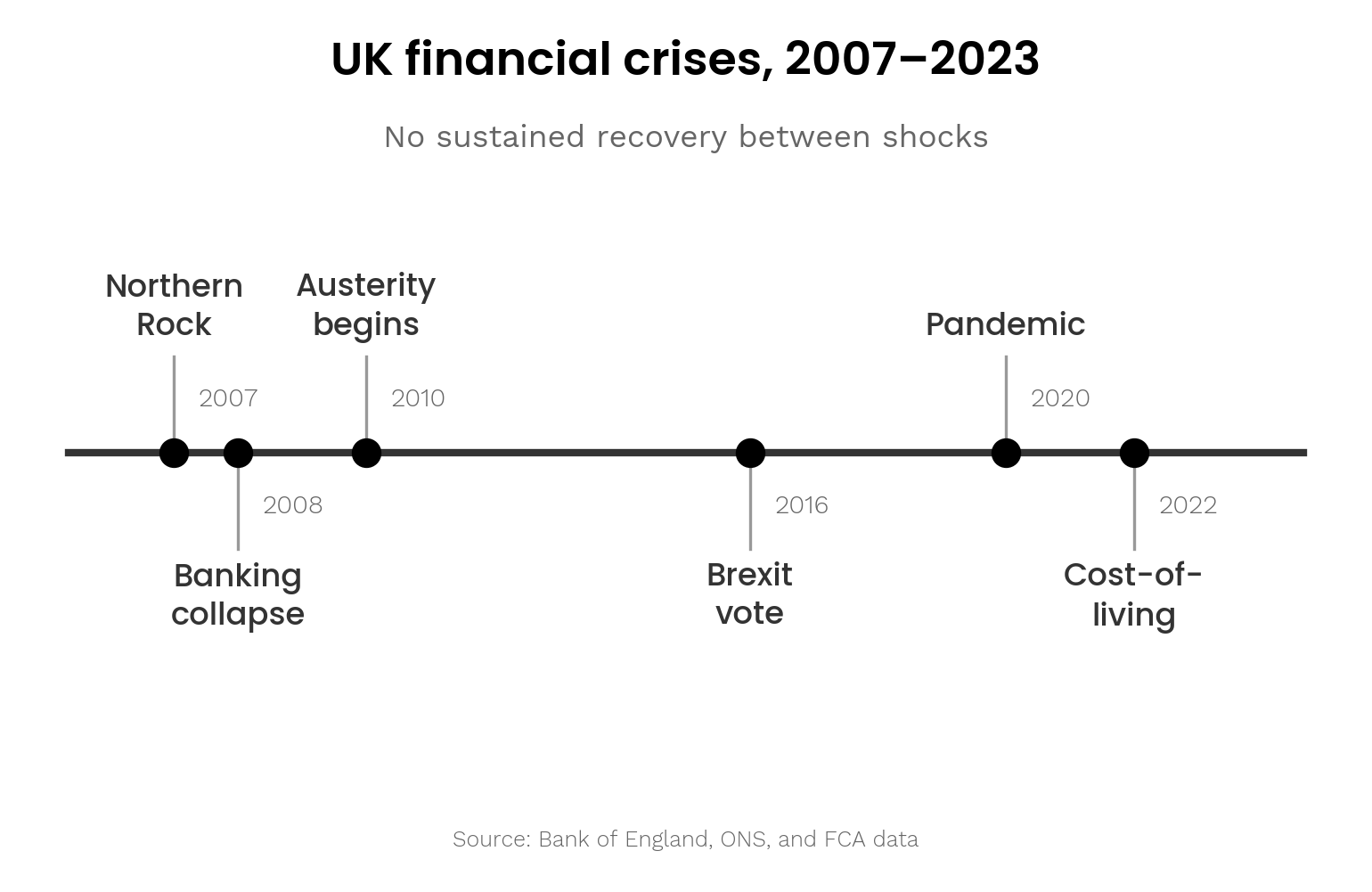
These are not just economic statistics. They describe a population whose financial psychology has been shaped by crisis after crisis, each one layering new anxieties on top of old ones. The Bank of England has described consumers as "scarred" by the sequence of shocks. The generational wealth data tells a similar story from a different angle: research from the Institute for Fiscal Studies shows that the difference in typical wealth between someone in their early 60s and someone in their early 30s has more than doubled in real terms since the mid-2000s. Only 36 per cent of people born in the 1980s were homeowners by age 30, compared with over 60 per cent for those born in the 1950s and 1960s. Mike Brewer's 2025 Gresham College analysis puts the wealth gap between the top end and middle Britain at £1.27 million - 17 per cent more than in 2006.
The compressed nature of these crises matters psychologically. Previous generations had recovery periods between shocks. For example the post-war generation had two decades of growing prosperity before the 1970s stagflation hit. The current generation has had no such breathing room. The Bank of England's observation about "scarred" consumers is more than metaphor. Each crisis leaves psychological damage: lower trust, higher anxiety, changed spending habits…and that damage has not healed from one crisis before the next one arrives.
Ulrike Malmendier's research at UC Berkeley puts hard numbers on this effect. People who live through a major economic downturn remain more risk-averse in their financial decisions for decades afterwards. The effect is strongest for those who experienced the crisis during their formative years, roughly ages 18 to 25. A generation that came of age during the 2008 crash, then entered the workforce during austerity, then lived through a pandemic, carries a psychological profile that no previous British generation has matched. They are not just financially poorer than their parents at the same age. They are psychologically different in their relationship with money, more cautious, less trusting of institutions, more anxious about the future.
There is a large and growing portion of the British population for whom the financial system feels less like a structure that supports them and more like a set of forces that happen to them. Understanding the psychology of that experience is not an academic exercise. It is, for millions of people, a daily reality.
What this series is not
My intention in this Crisis Money series is not to provide a personal finance guide on where to invest or how to budget. Although I’m intending to draw on history extensively, I’m not seeking to provide a complete history of British financial crises. The research in behavioural economics has sometimes been used to justify paternalism, but I won’t be an argument that people are irrational and need to be protected from themselves.
My aim is to provide something closer to “a field guide”. If we understand the psychological forces that act on us during a financial crisis, then we are better equipped to recognise them when they arrive. We cannot eliminate loss aversion or the herding instinct, but we can learn to notice when they are operating. Optimistically, that awareness, by itself, changes the decisions we make. Perhaps not always and not perfectly, but hopefully in ways that the research can quantify.
In this series we will be discussing some arguments about system design. If the people using the financial system are predictably affected by fear, herding, cognitive overload, shame and fairness perception, then surely the system itself should be designed with those realities in mind, rather than assuming they do not exist. The auto-enrolment pension success showed what is possible when system designers take human psychology seriously. The Northern Rock deposit insurance failure showed what happens when they do not. The gap between those two examples is where most of British financial policy still sits.
And the speed at which that gap matters is accelerating. In 2007, Northern Rock's run played out over about a week. In March 2023, Silicon Valley Bank in the United States lost $42 billion in deposits in a single day. Cookson and colleagues at the FDIC called it the first Twitter-fuelled bank run.2 The herding instinct, the narrative contagion, the fear response: they all still work the same way. They just work faster now. It will not be the orderly queue outside Northern Rock in September 2007. The next version of that queue will not be visible. It will happen in seconds, across millions of screens.
Next time: what financial dread actually does to your body. A derivatives trader noticed his own hands shaking during the 1998 Russian default, left Wall Street, and spent the next decade measuring what fear does to the people who move markets. His findings apply to anyone who has ever stared at a falling balance.
Next in this series: Fear and the body. If this was useful, subscribing gets you the rest of the series as it lands.
Reinhart, C. & Rogoff, K. (2009) This Time Is Different: Eight Centuries of Financial Folly. Princeton University Press. The definitive study of recurring financial crises across 66 countries.
Cookson, J.A. et al. (2023) "Social Media as a Bank Run Catalyst." FDIC Working Paper. Documents the role of Twitter in the Silicon Valley Bank collapse; essential for understanding how herding now operates at digital speed.