

This is part 5 of Crisis Money, a Money Outsider series about what financial crises do to our minds, and what our minds do back. It stands on its own, but part 3 covered what financial fear does to ordinary savers.
In the spring of 1720, Isaac Newton sold his shares in the South Sea Company for a profit of roughly £7,000. It was a sensible decision. The stock had risen sharply on little more than speculative enthusiasm and a vaguely defined monopoly on trade with South America. Newton, who held the position of Master of the Royal Mint and was by any measure one of the most analytically gifted people alive, had looked at the numbers, assessed the risk, and taken his money off the table.
Then he watched the price keep climbing.
Over the following weeks, Newton's friends, colleagues, and social circle continued to buy. The talk in London coffeehouses was of fortunes being made overnight. People who had never previously traded stocks were mortgaging property to invest. By June, with the share price still rising, Newton bought back in, this time with a much larger position. He invested close to £26,000, a sum that represented the vast majority of his personal wealth.
By December the bubble had burst. South Sea Company shares, which had peaked at over £1,000, fell below £200. Newton's losses came to roughly £20,000, equivalent to several million pounds today. The mathematician Andrew Odlyzko, who reconstructed Newton's trades from surviving records in a 2019 paper for Notes and Records of the Royal Society, calculated a capital loss of around 77 per cent.1 Newton is said to have remarked afterward that he could calculate the motions of heavenly bodies but not the madness of people. (The quote, as Odlyzko notes, cannot be reliably traced to Newton's own writings. It was first attributed to him decades after his death. But its popularity tells us something about how much we want to believe that intelligence protects us from crowd behaviour. It doesn't.)
What happened to Newton is not a historical curiosity. It is a pattern that repeats with remarkable consistency across centuries, currencies, and asset classes. A person makes a rational assessment. The crowd moves in a different direction. The person holds their position for a while, then joins the crowd, often at the worst possible moment. The sequence played out in the South Sea Bubble of 1720, the dot-com mania of 1999, the sub-prime mortgage frenzy of 2006, the cryptocurrency surge of 2021, and the pandemic-era meme stock explosion. The technology changes. The asset class changes. The underlying human behaviour does not.
This post is about why. Why do intelligent, informed, otherwise rational people abandon their own judgement and follow the crowd? The answer involves economics, neuroscience, career incentives, social media algorithms, and a British cultural habit of watching what the neighbours do before making any decision about money. It also involves a harder question, one that most writing about herd behaviour avoids: what if, sometimes, following the crowd is actually the right thing to do?
And it involves Newton, who is often held up as proof that even geniuses are helpless against market manias. That framing is too flattering. Newton didn't fail because he was human. He failed because being intelligent didn't protect him from the specific psychological mechanism, the pull of the herd, that this post will describe. Intelligence is no defence against conformity. If anything, intelligent people are better at constructing post-hoc justifications for following the crowd, which makes the problem worse, not better.
The mechanics of herding
In 1992, three economists published a paper in the Journal of Political Economy that gave herding a formal structure. Sushil Bikhchandani, David Hirshleifer and Ivo Welch described what they called an information cascade: a sequence in which individuals, acting rationally, observe the choices of those ahead of them and conclude that the crowd's collective behaviour reveals information worth following, even when their own private information suggests something different.2
The logic is surprisingly clean. Imagine you are deciding whether to invest in a new company. You have done your own research and you're mildly sceptical. Then you watch ten people ahead of you, each with their own analysis, all invest. You don't know what their individual analyses said. But the collective signal, ten out of ten choosing to invest, is hard to ignore. At some point, a rational person concludes that whatever the crowd has seen probably outweighs what they've seen alone. So they invest too. And the eleventh person, watching, reaches the same conclusion. The cascade has started.
This is what makes information cascades so different from simple peer pressure. The person joining the cascade is not being irrational. Given what they can observe, following the crowd is a reasonable inference. If ten informed people have all reached the same conclusion, the probability that they're all wrong is, on the face of it, low. The difficulty is that those ten people may each have been following the same logic: watching the person before them and suppressing their own doubts. The collective signal looks strong. The information underneath it may be thin.
Bikhchandani, Hirshleifer, and Welch made two observations about information cascades that are worth holding onto. The first is that cascades are self-reinforcing. Each new person who follows the crowd adds to the signal that future observers will use. The crowd gets bigger, the signal gets stronger, and the cost of dissenting increases. The second observation, which receives far less attention, is that cascades are fragile. Because each person in the chain is suppressing their own information, the whole structure can collapse the moment a single credible contrary signal appears. One person with convincing evidence that the crowd is wrong can shatter the cascade entirely. The speed of both formation and collapse is part of what makes financial bubbles so violent in both directions.
A 2024 review confirmed that the core dynamics Bikhchandani, Hirshleifer, and Welch identified have replicated consistently across thirty years of laboratory experiments and real-world market data. The model is one of the most robust in behavioural economics.3
But information cascades describe a process. They don't explain why it feels so uncomfortable to stand apart from a group, even when your own reasoning tells you to. For that, you need a brain scanner.
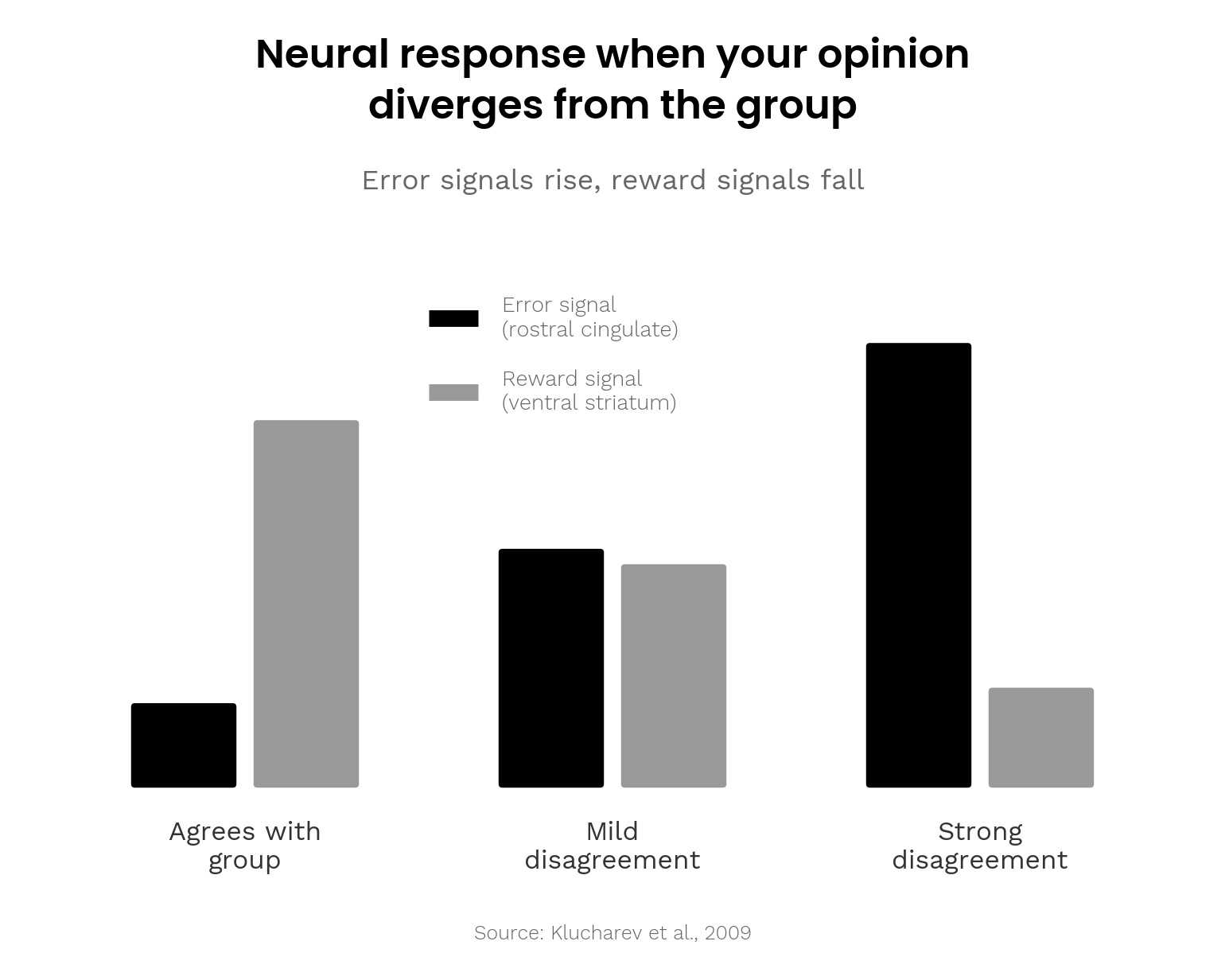
In 2009, Vasily Klucharev and his colleagues at the Donders Institute in the Netherlands published a study in the journal Neuron that opened a window onto the neural machinery of conformity.4 The study design was simple. Participants rated the attractiveness of a series of faces while lying in an fMRI scanner. After each rating, they were shown the average rating from a group of peers. Sometimes the group agreed with them. Sometimes it didn't.
When the participant's rating diverged from the group's, two things happened inside their brain. Activity spiked in the rostral cingulate zone, a region of the posterior medial frontal cortex that is associated with detecting errors. It's the same area that lights up when you make a mistake on a cognitive task and realise you've got the wrong answer. Simultaneously, activity changed in the ventral striatum, a reward-processing region. The brain was, in effect, treating disagreement with the group as a mistake and agreement as a reward. The amplitude of these signals predicted whether the participant would change their rating to match the group's in a follow-up session thirty minutes later. The stronger the error signal, the more likely they were to conform.
What Klucharev had found was that the brain has, in effect, a built-in conformity enforcer. It doesn't just notice social disagreement. It codes it as an error, the same way it codes a wrong answer on a maths test. And the strength of the coding predicted behaviour. People whose brains generated stronger error signals were more likely to change their minds to match the group. Conformity wasn't a choice. It was a neural reflex, operating below conscious awareness.
This was correlation. To establish causation, Klucharev and colleagues ran a follow-up experiment in 2011, published in the Journal of Neuroscience.5 This time they used transcranial magnetic stimulation to temporarily suppress activity in the posterior medial frontal cortex, the region that had generated the error signal. When they did, conformity dropped. Participants whose error-detection region had been dampened were less likely to shift their ratings toward the group's. The relationship was causal: reduce the brain's error signal for social disagreement, and people become more willing to stick with their own judgement.
The implications for financial markets are uncomfortable. Herding is not just a product of rational inference, as the cascade model suggests. It is also wired into neural architecture. The brain treats going against the group as a mistake, at a level below conscious deliberation. A fund manager who holds a contrarian position isn't just taking a financial risk. Their brain is generating a steady, low-grade error signal, telling them something is wrong. Holding that position requires overriding that signal, continuously, for as long as they remain the outlier. Most people can't do it for very long.
Career herding
Nobody ever got fired for losing money the same way everyone else did.
There is a joke among fund managers that nobody ever got fired for buying IBM. The equivalent in investment management is that nobody ever got fired for losing money the same way everyone else did.
In 1990, David Scharfstein and Jeremy Stein published a paper in the American Economic Review that formalised this intuition.6 They showed that when investment managers are evaluated against their peers, a powerful asymmetry emerges. If you follow the crowd and the crowd turns out to be wrong, you're one of many. The explanation is easy: "Nobody saw it coming." The reputational damage is shared across the entire industry, and individual careers survive. But if you break from the crowd and you turn out to be wrong, you're alone. You made a bet nobody else made, and you lost. The explanation required is personal. You got it wrong. Your career may not survive.
Scharfstein and Stein's model predicted that professionals with the best information, the ones most likely to know the crowd is wrong, would also face the strongest incentive to follow it. The better your private information, the more conspicuous your deviation from consensus, and the greater the career risk if the deviation doesn't pay off. The result is an industry in which the people best equipped to challenge herd behaviour are the least likely to do so.
Consider how this works in practice. A fund manager at a large UK asset management firm in early 2007 might have had private intelligence suggesting that mortgage-backed securities were mispriced. She might have been right. But if she reduced her fund's exposure while every competitor maintained theirs, and the market continued rising for another six months (which it did), her fund would underperform. Her quarterly review would be uncomfortable. Her clients might withdraw money. Her boss, who was being benchmarked against the same competitors, would ask difficult questions. The rational career move was to stay with the herd, even if her analysis said the herd was heading for a cliff. When the crash came, she would lose money, but so would everyone else, and "everyone got it wrong" is a survivable narrative in a way that "I got it wrong while everyone else made money" is not.
John Maynard Keynes saw this clearly in 1936, though he expressed it differently. In The General Theory of Employment, Interest and Money, he compared the stock market to a newspaper beauty contest in which readers were asked to pick the prettiest faces from a set of photographs.7 The prize went not to whoever picked the objectively prettiest face, but to whoever picked the face that received the most votes. The winning strategy, Keynes argued, was not to assess beauty at all but to assess what other people would find beautiful. And then to go a level deeper: what other people thought other people would find beautiful. The result was that prices reflected not value, but expectations about expectations.
A 2020 study in the International Review of Financial Analysis found that UK mutual fund managers exhibit herding behaviour driven by investor sentiment.8 When clients are optimistic, managers pile into the same trades. When clients turn fearful, they exit together. The study measured herding intensity across different market conditions and found it strongest during periods of high uncertainty, precisely when independent analysis would be most valuable. Fund managers are not stupid. They are responding rationally to career incentives that punish independent thought and reward consensus.
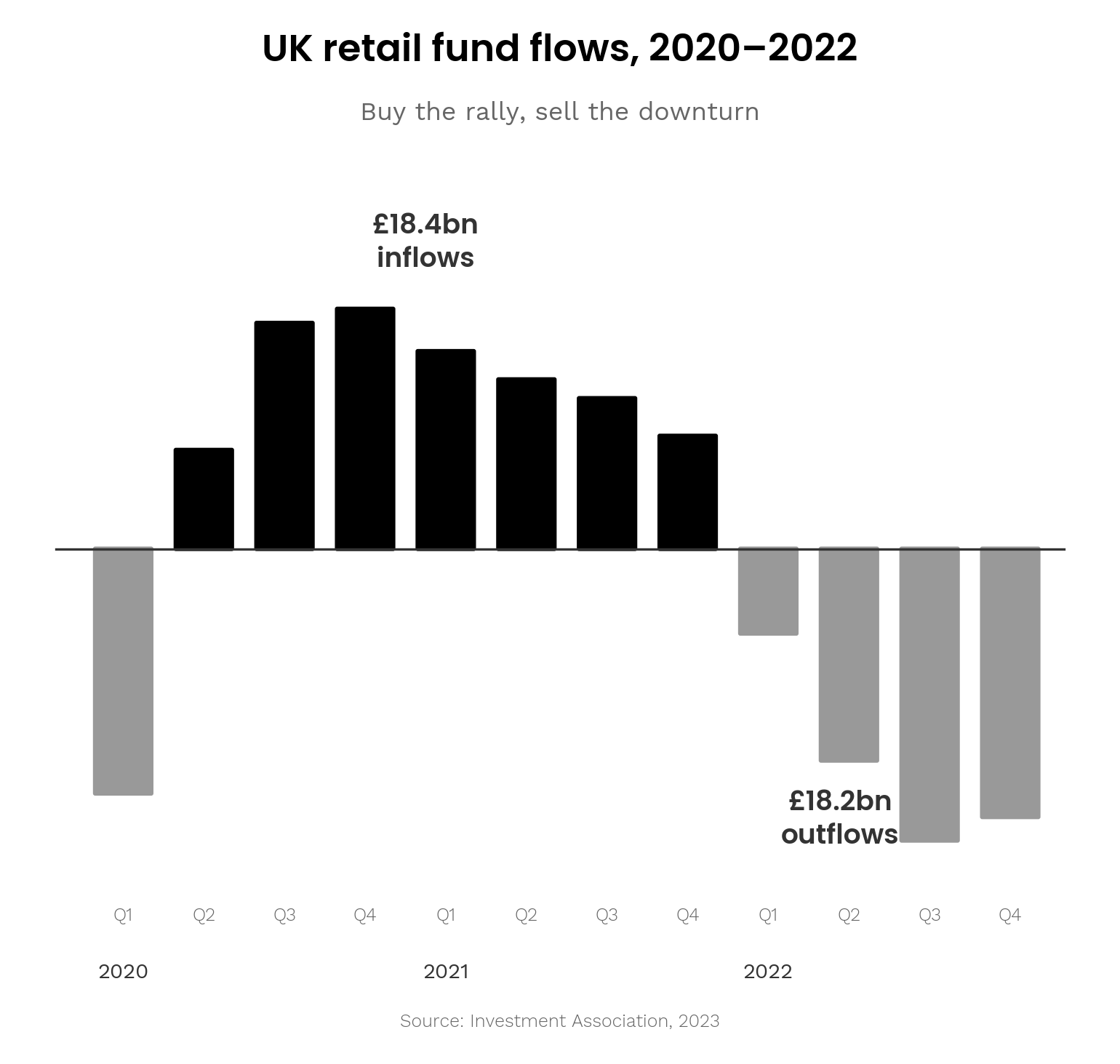
The cost of this dynamic falls disproportionately on the people furthest from the decision. When UK equity fund managers herd into the same positions during a boom, they push prices higher than fundamentals justify. When they herd out during a crash, they push prices lower. Investment Association data shows the pattern with painful clarity: £18.4 billion of inflows to UK equity funds during the 2020-21 rally, followed by £18.2 billion of outflows in 2022.9 Money arriving at the top and leaving at the bottom. The fund managers are following their career incentives. The cost is borne by the pension holders, ISA savers, and retail investors whose money moves in and out at exactly the wrong times.
Keynes's beauty contest, written nearly ninety years ago, remains the most accurate description of how professional investment actually works. The question is not "what is this asset worth?" The question is "what does everyone else think this asset is worth, and will they still think it tomorrow?" When enough people are asking that question instead of the first one, markets stop being mechanisms for price discovery and become mechanisms for the amplification of consensus.
Newton followed the herd on the strength of coffeehouse talk and letters from friends, and it took months to ruin him. The modern herd moves in minutes, on screens, with the whole crowd visible at once. In the next part: GameStop, the UK crypto boom, the Northern Rock queue, and the awkward question of when the crowd is actually right.
Next in this series: The herd goes digital. If this was useful, subscribing gets you the rest of the series as it lands.
Further reading: Mackay, C. (1841) Extraordinary Popular Delusions and the Madness of Crowds. The original study of financial manias, still readable and still relevant nearly two centuries later.
Odlyzko, A. (2019) 'Newton's financial misadventures in the South Sea Bubble', Notes and Records: The Royal Society Journal of the History of Science, 73(1), pp. 29-59.
Bikhchandani, S., Hirshleifer, D. & Welch, I. (1992) Information Cascades. Journal of Political Economy, 100(5), pp. 992-1026.
2024 review of information cascades. Source: Bikhchandani, S., Hirshleifer, D. & Welch, I. (1992, reviewed 2024) 'A Theory of Fads, Fashion, Custom, and Cultural Change as Informational Cascades', Journal of Political Economy, 100(5), pp. 992-1026. Over 30 years of successful replication.
Klucharev, V. et al. (2009) Reinforcement learning signal predicts social conformity. Neuron, 61(1), pp. 140-151.
Klucharev, V. et al. (2011) Downregulating the posterior medial frontal cortex. Journal of Neuroscience, 31(31), pp. 11193-11200.
Scharfstein, D. & Stein, J. (1990) Herd Behavior and Investment. American Economic Review, 80(3), pp. 465-479.
Keynes, J.M. (1936) The General Theory of Employment, Interest and Money.
International Review of Financial Analysis (2020) UK mutual fund herding behaviour driven by investor sentiment during high uncertainty periods.
Investment Association (2022) Fund flow data. GBP 18.4 billion equity inflows 2020-21; GBP 18.2 billion outflows 2022.