

This is part 4 of Crisis Money, a Money Outsider series about what financial crises do to our minds, and what our minds do back. It (hopefully) stands on its own, but part 3 covered what fear does to the bodies of professional risk-takers.
Fear in the body
The same hormonal machinery exists in every person with a pension, an ISA, or a savings account. The cortisol response is triggered by a letter from your pension provider showing a 25 per cent decline or an email from your bank about your mortgage rate or a conversation with a colleague who mentions they’ve “moved everything to cash”. Whilst the trader has a risk manager, a compliance team and colleagues who have survived crashes before, the retail investor has an echo-chamber on social media and a sense that something terrible is happening to their future.
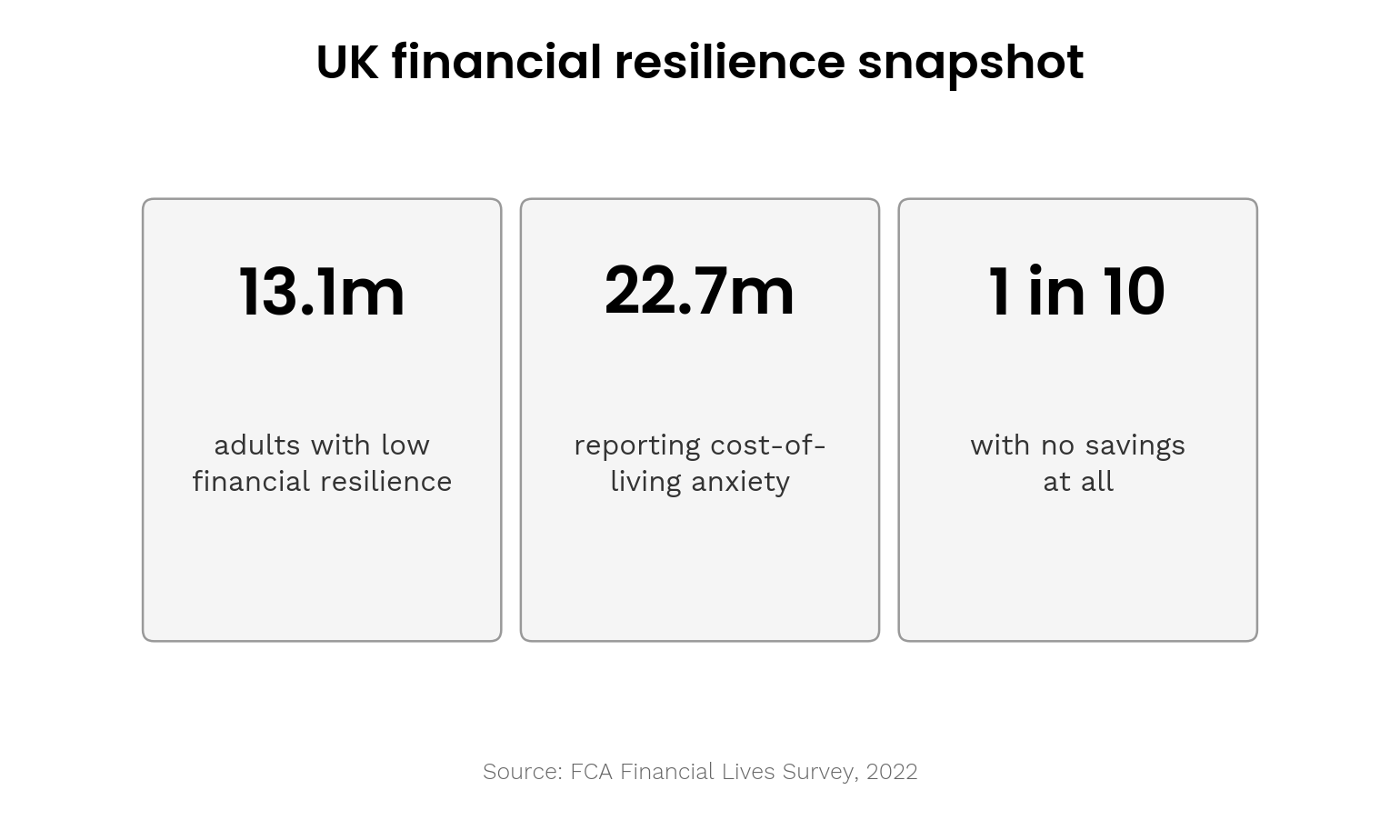
The FCA's Financial Lives 2024 survey is the most comprehensive picture we have of financial wellbeing in the UK. It surveyed 17,950 people and found that 13.1 million UK adults, 24 per cent of the population, had what the regulator classifies as "low financial resilience."1 These are people who have missed a payment, are struggling to meet their financial commitments, or lack sufficient savings to weather a difficulty. One in ten had no savings at all. A further 21 per cent had less than £1,000. In the twelve months to January 2024, 43 per cent of adults, roughly 22.7 million people, reported anxiety or stress caused by the rising cost of living. A year earlier, at the peak of the energy price shock, that figure had been 54 per cent.
Pair that with the Mental Health Foundation's 2023 polling of 6,000 UK adults, which found that one in three said worries about paying bills had made them anxious in the preceding two weeks.2 Or with research from St James's Place in 2024, which found that 47 per cent of UK adults said financial worries had affected their mental health. Among 18-to-34-year-olds, the figure was 66 per cent.3
These are not small effects in a marginal group. They describe a country in which financial anxiety is a mass experience, touching nearly half the adult population and two thirds of its youngest working adults. Between 2022 and 2024, tens of millions of people experienced a level of financial stress that would be considered a mental health risk factor. The cost-of-living crisis was not a sudden market crash of the kind that makes newspaper front pages. It was a slow squeeze, playing out over utility bills and supermarket receipts. It produced anxiety levels comparable to those seen during the 2008 crash itself.
The clinical literature confirms what the surveys suggest. The Money and Mental Health Policy Institute found that approximately 46 per cent of people in problem debt have a mental health condition.4 Causation runs in both directions, making the relationship harder to untangle but no less devastating in practice. A 2024 population-based cohort study found that people experiencing financial hardship had significantly elevated risks of insomnia, poor sleep quality, and failure to meet sleep duration guidelines.5 Psychosocial factors, worry and rumination in particular, explained about 40 per cent of the link between financial difficulty and insomnia. A separate UK study found that students with high financial stress experienced poor sleep quality that then degraded their dietary choices, their physical health, and their academic performance.
Sleep matters more than it might seem in a piece about money. Working memory, emotional regulation, and decision-making quality all decline with sleep loss. A person who lies awake at 3am worrying about their overdraft is, the following morning, measurably less equipped to make good decisions about that same overdraft. It is a feedback loop running downhill: anxiety disrupts sleep, poor sleep impairs judgment, impaired judgment leads to worse financial choices, and worse financial outcomes generate more anxiety. The cycle is self-reinforcing, and it operates below the level of conscious control.
The cardiovascular evidence is grimmer still. A 2023 study found that economic uncertainty is associated with increased mortality from circulatory diseases, ischaemic heart disease, and cerebrovascular disease.6 Research using the UK Household Longitudinal Study found that increased economic insecurity was linked to adverse levels of HDL cholesterol, triglycerides, and C-reactive protein, all biomarkers for cardiovascular risk. The pathway from financial shock to cardiac event runs through chronic stress, inflammation, and the wear of sustained cortisol elevation on the vascular system.
There is something unsettling about laying all of this out in sequence: the hormonal loop on the trading floor, the cortisol-driven paralysis, the insomnia cascade, the cardiovascular damage. Each mechanism has been studied independently, published in a specialist journal, and discussed within its own academic silo. What no one seems to have done is stand back and look at the full picture. The financial fear response is not a single phenomenon. It is a system, running from the endocrine glands through the prefrontal cortex to the cardiovascular system, activated by the same stimulus: a threat to your financial security. And every part of the system makes every other part worse.
Selling at the bottom
In 1985, Hersh Shefrin and Meir Statman identified a pattern they called the disposition effect.7 Investors hold on to losing investments too long, hoping to avoid the pain of crystallising a loss, and sell winning investments too early, to lock in the pleasure of a gain. Loss aversion and the disposition effect are not the same thing, but they're related: the disposition effect is what happens when loss aversion meets a brokerage account.
In 1998, Terrance Odean tested the theory against real trading records.8 He analysed seven years of data from 10,000 individual accounts at a large US discount brokerage. The disposition effect was large and consistent. The stocks people sold for a gain went on to outperform the stocks they stubbornly held at a loss by 3.4 per cent over the following twelve months. In December, the pattern reversed slightly, as investors sold losers for tax purposes. The rest of the year, it held firm. People were paying a measurable cost for their inability to face up to a loss.
In normal market conditions, the disposition effect is a drag on returns. It's expensive but not catastrophic. People hold their losers too long, sell their winners too soon, and underperform the market by a few percentage points a year. It's the financial equivalent of a persistent low-grade fever: uncomfortable, costly over time, but survivable.
During a full-blown crisis, something different happens. The disposition effect breaks.
Nicholas Barberis, a Yale finance professor, documented the psychological sequence of the 2008 crash in a paper published in 2012.9 In the early months, from summer 2007 through the first half of 2008, loss aversion actually prevented selling. The FTSE 100 was down, pension statements were bad, but people couldn't bring themselves to crystallise a 20 per cent loss. They held. The disposition effect was doing what the disposition effect does: making people cling to losing positions.
Then Lehman Brothers collapsed on 15 September 2008. The losses steepened. Through October and November, markets fell further and faster. By early 2009, portfolios that had been down 20 per cent were down 40 per cent. And somewhere in that decline, a threshold was crossed. The pain of watching the number fall further exceeded the pain of realising the loss. The psychological dam broke. Paralysis gave way to capitulation. Investors sold in volume, at the worst possible prices, because the emotional cost of continuing to hold had become unbearable.
The FTSE 100 hit its crisis low of 3,512 on 3 March 2009. It had peaked at 6,731 in October 2007, a fall of almost 48 per cent.10 To put that in personal terms: a pension pot worth £200,000 in October 2007 (if invested in the FTSE 100) would have been showing roughly £104,000 by March 2009. For someone approaching retirement, looking at that number on a screen, the emotional response is not academic.
An investor who sold at that moment and moved to cash would have missed the recovery that took the index back above 5,000 by the end of 2009 and above 7,000 by 2015. The same £200,000 pot, left untouched, would have recovered its full value within two years and doubled within six. But "left untouched" requires a level of emotional composure that the cortisol research tells us is biologically difficult for most people to maintain during a sustained market downturn.
The Investment Association's fund flow data captures the pattern in aggregate. UK retail investors were net sellers of equity funds through the worst of the crisis, pulling money out at precisely the moment prices were cheapest.11 They then began re-investing months later, after the recovery was already well under way. They sold low and bought high. Every piece of financial guidance in existence tells you to do the opposite. Loss aversion made them do it anyway.
The 2022 cost-of-living crisis produced a related pattern, though the mechanism was different. The Investment Association recorded a record annual net outflow from UK retail funds of £25.7 billion, the first full-year net outflow in its data history.12 Funds saw outflows in ten out of twelve months. This was not panic selling driven by market fear. It was forced selling: people liquidating their ISAs and investment accounts because they needed cash to cover rent, energy bills, and food. The contrast with the previous two years was stark. In 2020 and 2021, UK retail investors had put in near-record inflows of £30.8 billion and £43.6 billion respectively. The reversal was total, and it was driven not by fear of the market but by the material pressure of rising prices on household budgets.
In both cases, the selling happened at the wrong time. In both cases, it fell hardest on people without financial buffers, without access to professional advice, and without the luxury of simply waiting.
There is a bitter irony in the Investment Association data. The same system that encourages people to invest for the long term, through workplace pensions, ISAs, and platform advertising that shows thirty-year performance charts, provides no mechanism to protect them from their own biology when a crisis arrives. The auto-enrolment system gets people into the market. Nothing in the system's design helps them stay there when their cortisol is elevated, their sleep is broken, and every instinct in their body is telling them to run.
The gender question
Chris Dawson's 2023 study in the British Journal of Psychology approached the gender gap in financial risk-taking from an angle that most financial research avoids.13 Instead of asking people hypothetical questions about gambles, he used data from 13,575 respondents to the UK British Household Panel Survey and measured loss aversion through real-world income changes: how much does a £1 drop in household income affect your psychological wellbeing, compared with a £1 gain?
His findings were clear on the surface. Women reported a lower willingness to take financial risks than men. Fifty-three per cent of that gap was explained by higher levels of loss aversion among women. A further 3 per cent was attributable to lower levels of financial optimism. Income losses were more psychologically painful for women than for men. Income gains felt roughly the same to both sexes.
Set alongside the Coates research, a picture forms. The testosterone-driven feedback loop that produces bull market overconfidence is predominantly a male phenomenon. Women's risk preferences are more stable across market conditions. Women may take less risk during booms, missing some upside, but they also tend to avoid the worst excesses of the bust. Coates argued that a more gender-diverse financial system would be a less volatile financial system. Dawson's data suggests he might be right, at least about the loss aversion half of the equation.
But the picture has complications that deserve honesty rather than a neat conclusion.
A 2024 meta-analysis on gender and loss aversion found that the answer depends entirely on how you define and measure it.14 Under one common experimental definition, women are more loss-averse. Under another, there's no gender difference at all. Under two further definitions, women are actually less loss-averse than men. The finding that women are "more risk-averse" may be partly an artefact of how questions are framed, which samples are recruited, and which definition of loss aversion the researchers happen to use. A 2022 replication study found no significant gender difference in financial risk aversion, contradicting earlier work.15
I don't think the research is mature enough to draw clean conclusions from. What it does tell us, usefully, is that loss aversion is not a universal constant. It varies between individuals, between genders, between age groups, and between economic contexts. The 2.5x ratio from Kahneman and Tversky is a population average. Some people experience losses at 1.5x intensity. Some at 4x. The variation matters more than the average, because the average obscures precisely the people who are most at risk during a crisis.
If you are a 28-year-old woman with a workplace pension she rarely checks, loss aversion during a downturn may barely register. If you are a 62-year-old man three years from retirement, checking his SIPP daily on his phone while the market drops, the same biological machinery is running at full intensity. Same brain architecture. Wildly different exposure to the fear response. Any system that treats these two people identically, which is to say, the system we currently have, is designed around an abstraction rather than a reality.
What this means
Financial fear is not a character flaw. It is not a sign of financial illiteracy or emotional weakness. It is a physiological response, operating at every level of the human system: hormonal, with cortisol flooding the bloodstream and testosterone amplifying your worst instincts; cognitive, with loss aversion distorting judgment in direct proportion to the stakes; physical, with disrupted sleep, elevated inflammatory markers and measurable cardiovascular damage; and behavioural, with the reliable pattern of selling at the worst moment and hoarding cash that should be deployed.
This response has been documented in every significant financial event in modern British history. The people who queued outside Northern Rock in September 2007 were not irrational. They were making a calculation under extreme uncertainty, and for those who had deposits above the guaranteed limit, they were right to queue. But millions of other people, across the months and years that followed, made decisions driven by a fear response that their conscious, rational minds could not override. They sold their equities at the bottom. They pulled their pensions into cash. They stopped contributing to investments that would have recovered. The cost, measured in retirement income lost, runs into the billions.
Understanding that the fear response is biological, not moral, is the first step toward managing it. The second step, as Benartzi and Thaler demonstrated three decades ago, is absurdly simple: stop checking your portfolio so often. Every time you open that app and see a red number, you pull the trigger on the loss aversion machinery. The machinery does not care about your thirty-year time horizon. It does not care about average annual returns. It cares about the threat directly in front of it, right now.
And the financial system, far from helping, actively makes this worse. Pension dashboards show daily fluctuations. Investment platforms send push notifications when markets move. Fund factsheets report monthly returns to three decimal places. Workplace pension statements arrive with graphs that make a temporary decline look like the edge of a cliff. The entire architecture is built as if the humans using it are rational agents who process information calmly and act in their long-term interest. They are not. They have amygdalas. They have cortisol receptors. They have the same fight-or-flight wiring as every other mammal on the planet.
The cost of pretending otherwise falls hardest on those with the smallest financial buffers and the least access to the professional advice that might, in the moment of panic, talk them back from the edge. A wealthy investor with a financial adviser will get a phone call during a crash telling them to hold steady. A care worker with an auto-enrolled workplace pension worth £8,000 will get an app notification showing her pot is down 22 per cent, and no one to explain why that number, frightening as it looks, is a temporary feature of a long-term investment. The biology is the same. The support is not and the system is designed as though neither exists.
Whether we are, in the end, frightened animals making financial decisions has only one honest answer. We are.
John Coates left Wall Street to find out why his body overruled his brain. What he found was that the same hormonal machinery runs in every person with a financial stake in an uncertain world. The trader on the Deutsche Bank floor in 1998, hands steady during the boom and shaking during the crash, was not an outlier. He was a preview. His body was doing what all our bodies do when the numbers on the screen start falling. The question he asked in that laboratory in Cambridge, whether we are, in the end, frightened animals making financial decisions, has only one honest answer. We are. The financial system just hasn't caught up with that fact.
The fear this piece describes plays out inside a single body, one nervous system at a time. Crises spread between bodies too, through watching what everyone else does and doing the same, and that is where this series goes next. Even Isaac Newton, the most rational man of his age, could not resist following the crowd into the South Sea Bubble.
Next in this series: Why we follow everyone else off the cliff. If this was useful, subscribing gets you the rest of the series as it lands.
Financial Conduct Authority (2024) Financial Lives 2024 Survey: Key Findings. 17,950 respondents; 24% classified as having low financial resilience.
Mental Health Foundation (2023) Money and Mental Health Survey. 6,000 UK adults, one in three anxious about paying bills.
St James's Place (2024) Financial Wellbeing Research. 47% of UK adults reported financial worries; 66% among 18-34 year-olds.
Knapp, M. et al. (2012) 'Debt and mental health', in Personal Debt & Mental Health. London: Royal College of Psychiatrists/BMJ. 45% with problem debt have mental health conditions.
Sinha, S. et al. (2024) 'Financial hardship and sleep outcomes: a population-based cohort study', Sleep Health, 10(2), pp. 145-153.
Wersing, C. et al. (2023) 'Economic uncertainty and circulatory disease mortality', PLoS Medicine. Association with ischaemic heart disease and CVD.
Shefrin, H. & Statman, M. (1985) Disposition effect. Journal of Financial and Quantitative Analysis, 20(4).
Odean, T. (1998) Are Investors Reluctant to Realize Their Losses? Journal of Finance, 53(5), pp. 1775-1798.
Barberis, N. (2012) 'Psychology and the Financial Crisis of 2007-2008', Yale School of Management Working Paper.
London Stock Exchange historical market data. FTSE 100 fell from 6,731 (October 2007 peak) to 3,512 (March 2009 trough), a decline of 47.8%.
The Investment Association (2023) annual fund flow statistics. Net sellers of equity funds during 2008 crisis.
The Investment Association (2023) '2022 ends with a record annual outflow from retail funds of GBP 25.7 billion', Press Release, 9 February 2023.
Dawson, C. (2023) 'Gender differences in optimism, loss aversion and attitudes towards risk', British Journal of Psychology, 114(4), pp. 928-944.
Bouchouicha, R., Deer, L., Eid, A.G. et al. (2019) 'Gender Effects for Loss Aversion: Yes, No, Maybe?', Journal of Risk and Uncertainty, 59, pp. 171-184. Four definitions of loss aversion produced four contradictory gender effects. See also Georgalos, K. (2024) 'Gender effects for loss aversion: A reconsideration', Journal of Economic Psychology, 105.
Giannikos, C.I. & Korkou, E.D. (2025) 'Are Women More Risk Averse? A Sequel', Risks, 13(1), 12. Replication of Jianakoplos & Bernasek (1998) using 2022 US Survey of Consumer Finances data with refined wealth measurement. Found no significant gender difference in financial relative risk aversion.