

This is part 3 of Crisis Money, a Money Outsider series about what financial crises do to our minds, and what our minds do back. It (hopefully) stands on its own, but part 2 covered why the same crisis psychology returns, decade after decade.
In 1998, a derivatives trader at Deutsche Bank in New York noticed something odd about his own body.
During a bull run his hands were steady, his thinking quick, his appetite for risk almost physical. He slept well, ate well and felt “invincible”. Then the Russian government defaulted on its debt and the mood on the trading floor changed in a way that no pricing model could have predicted. His fingers hesitated over the keyboard. His sleep broke apart. His stomach clenched each morning before the opening bell. His colleagues, among the most analytically trained people on Wall Street, were making decisions that looked like the behaviour of frightened animals.
The trader's name was John Coates. He had spent thirteen years on Wall Street, working derivatives desks at Goldman Sachs, Merrill Lynch and finally Deutsche Bank, where he ran a trading operation specialising in the tails of probability distributions (extreme outlier events). With a PhD from Cambridge, he was not short of analytical training, yet the question he couldn't shake was disturbing: what if they actually were frightened animals? What if the decisions being made on trading floors during a financial crisis had less to do with spreadsheets and pricing models and more to do with cortisol, testosterone and the ancient mammalian fear response?
In 2004, Coates left Wall Street and returned to Cambridge to find out. He started collecting saliva samples from City of London traders, twice a day, measuring their hormone levels while they worked. He would arrive on the trading floor early and then return in the afternoon. He did this for weeks at a time, in conditions ranging from quiet, profitable markets to the kind of volatility that made grown men swear at screens.
What he discovered over the following decade would reframe how we understand financial risk. His findings should unsettle anyone who believes that markets are driven by rational calculation. They certainly unsettled the traders and the academic economists who reviewed his papers. And they should unsettle you, because the same biological machinery that Coates measured in City traders is running, right now, in the body of every person in Britain who has a pension, a mortgage or a savings account.
Before looking at Coates findings, we need to start with a more fundamental question: why do human beings experience financial losses so much more intensely than financial gains? The answer takes us to a psychology laboratory in Jerusalem, in 1979, and to a pair of researchers whose work would change how we understand decisions about money, risk, and everything that connects them.
The asymmetry
Daniel Kahneman and Amos Tversky spent years asking people to make simple choices between gambles. Would you rather have a guaranteed £500, or a 50/50 chance of winning £1,000? Most people took the sure thing. Would you rather lose £500 for certain, or take a 50/50 chance of losing £1,000? Most people gambled. The expected value is identical in each case, yet the choices people made were not. The pattern was consistent across thousands of subjects and it violated everything that classical economics assumed about how rational agents weigh outcomes.
In 1979, Kahneman and Tversky published Prospect Theory: An Analysis of Decision Under Risk.1 The paper would eventually help win Kahneman the Nobel Prize in Economics. Its central insight was deceptively simple: people don't evaluate outcomes in absolute terms. Instead, they evaluate them relative to a reference point, usually whatever they currently have. The function is not symmetrical: the pain of losing £100 is more intense, psychologically, than the pleasure of gaining £100.
How much more intense? Kahneman and Tversky's original experiments suggested a ratio of about 2 to 2.5 times. A loss feels roughly twice as bad as an equivalent gain feels good. They called this asymmetry loss aversion and it offered a tidy explanation for a cascade of financial behaviour that economists had been labelling "irrational" for decades.
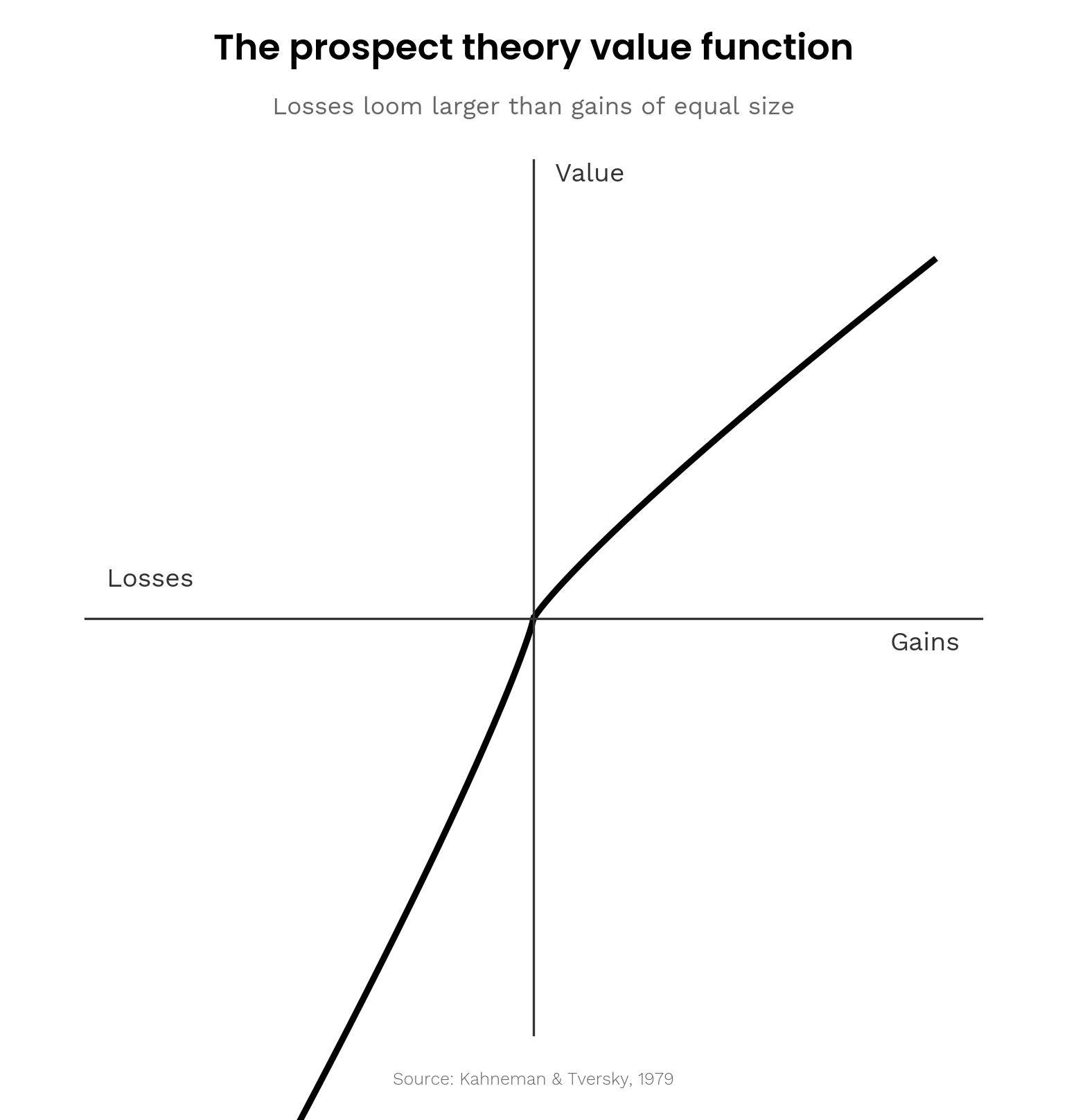
During the financial crisis in 2008, UK pension holders watched their retirement pots drop by 30 or 40 per cent over a period of months. If losses are felt at twice the intensity of gains, a 30 per cent fall doesn't feel like the mirror image of a 30 per cent rise. It feels closer to a 60 per cent hit. Brain imaging studies have since shown that financial losses activate the anterior insula and other neural circuits associated with physical pain and disgust.2 The 2008 pension losses weren't just disappointing. For the people experiencing them, they were physically painful in a way that neuroscientists can now measure on a scan.
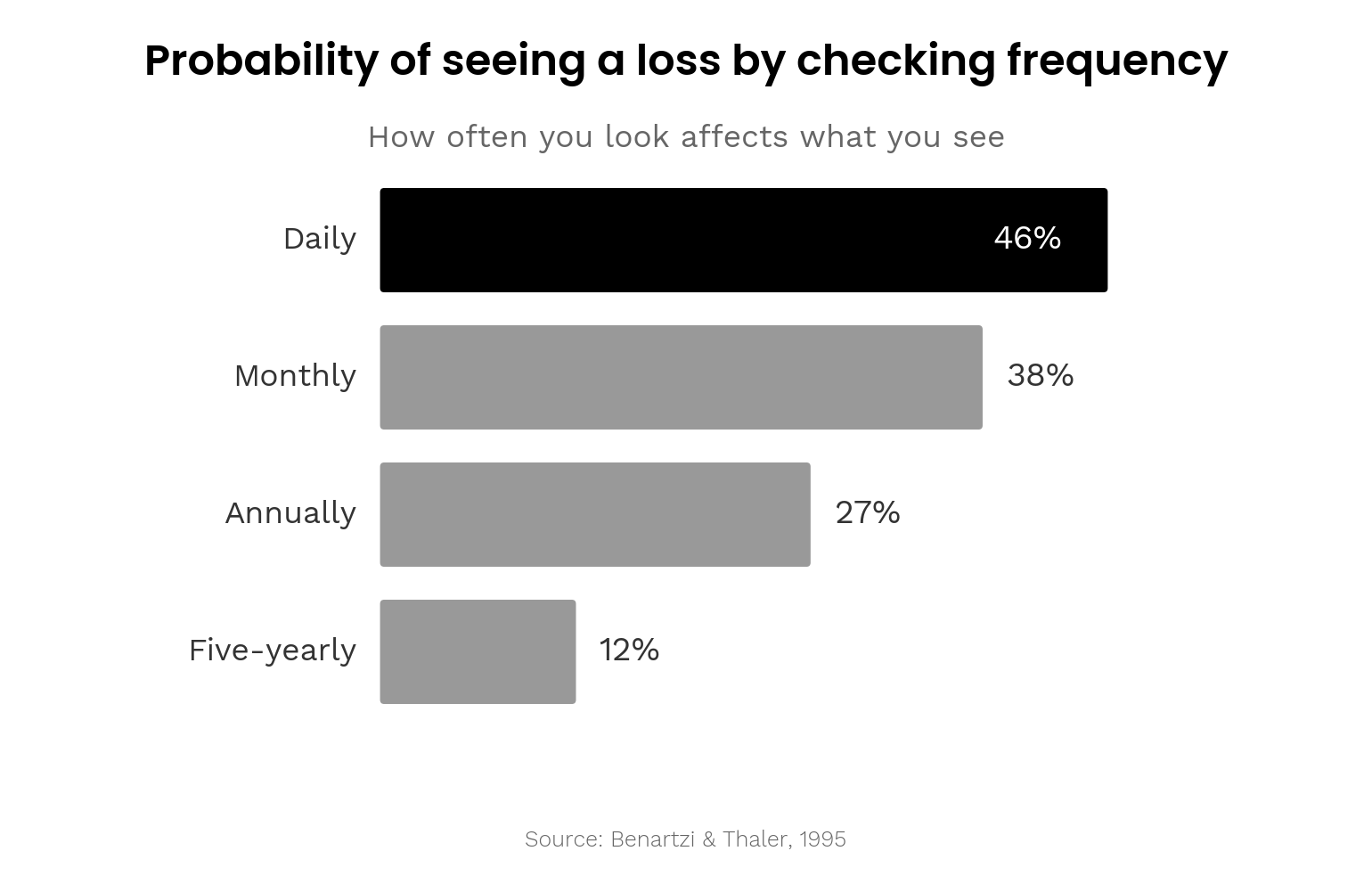
In 1995, two economists at the University of Chicago, Shlomo Benartzi and Richard Thaler, built on Kahneman and Tversky's work with an observation that still hasn't properly filtered through to the people who design pension systems. They called it myopic loss aversion.3 Their insight was straightforward: people check their portfolios too often. When you evaluate your pension fund's performance monthly rather than annually, you encounter more periods showing a loss, because stock markets are volatile in the short term even when they trend upward over decades. Each encounter with a negative number triggers the loss aversion response: a small chemical jolt of distress; tightening in the chest; a thought, conscious or not, that maybe you should move to something safer.
Benartzi and Thaler ran simulations to quantify the effect. The probability of seeing a loss on a diversified equity portfolio on any given trading day is roughly 46 per cent. Check monthly, and it drops to about 38 per cent. Check once a year, and it's around 27 per cent. Check every five years and losses become rare. The underlying asset is the same in every case. Only the frequency of emotional exposure changes. Their simulations showed that investors behave as if they're operating with a time horizon of about one year, even when their actual investment horizon is twenty or thirty years. The result is that frequent checkers end up holding far less in equities than infrequent checkers and they earn lower returns over their lifetimes as a consequence.
Rather than a flaw in either the market or the investor, this is a flaw in the interface between the two. Every push notification from a trading app, every monthly statement email from an investment platform, every red number on a portfolio dashboard is a trigger. The information is accurate. The emotional response it provokes is, from an investment perspective, counterproductive. The more accessible investing has become, the worse the problem. In 1995, when Benartzi and Thaler published their paper, checking a portfolio meant calling your broker or waiting for a quarterly statement. In 2025, it means opening an app on the device in your pocket, which most people do dozens of times a day. The frequency of emotional exposure has increased by an order of magnitude. The loss aversion machinery hasn't changed at all.
Now here's where the picture gets more complicated, and more interesting.
In 2024, Lukasz Walasek, Matthew Mullett, and Neil Stewart published a meta-analysis in the Journal of Economic Psychology that re-examined the loss aversion evidence from scratch.4 They collected every study that had fitted prospect theory's loss aversion parameter, known as lambda, to individual choices between risky gambles. The sample turned out to be surprisingly small for such a famous finding: just 17 published studies comprising 19 data sets. And the mean loss aversion coefficient they calculated was 1.31, with a 95 per cent confidence interval from 1.10 to 1.53. That is a long way from Kahneman and Tversky's original estimate of 2.0 to 2.5. Much of the available data, the authors noted, was of poor quality, making precise estimates difficult.
Separately, a 2023 study in Judgment and Decision Making found that loss aversion doesn't reliably appear for small stakes at all. It emerges only weakly and only for losses above roughly $40.5
I want to be careful with this, because the headline version of the meta-analysis, "loss aversion is weaker than we thought" misses the point that matters for this series. What the evidence actually shows is that loss aversion scales with stakes. Small, everyday financial decisions may not trigger it. Lose £5 on a bet and you'll barely notice the asymmetry. But the kinds of losses people experience during a genuine financial crisis, where pension pots drop by tens of thousands of pounds over weeks, where house prices fall by 15 per cent in a year, where a lifetime of savings shrinks visibly on a screen, these are precisely the conditions under which loss aversion hits hardest. A 2020 global replication study, spanning 19 countries and 13 languages, confirmed that prospect theory's core predictions hold, particularly in the domain of large losses under uncertainty.6
So the picture that emerges is more nuanced than the textbook version, and more useful. Loss aversion is not a fixed constant baked into every human brain at the same intensity. It is a response that scales with the magnitude of what you stand to lose. Financial crises, by definition, are the moments when the stakes are highest. Which means they are the moments when loss aversion dominates most completely.
The hour between dog and wolf
The title comes from the French phrase l'heure entre chien et loup, the twilight hour when you can no longer tell the dog from the wolf. John Coates uses it as a metaphor for the moment when a rising market tips into mania, or a falling market tips into panic: the moment when your body crosses a hormonal threshold, and confidence becomes recklessness, or caution becomes paralysis. It is also the title of his 2012 book which laid out a single uncomfortable argument that the financial industry has mostly preferred to ignore.7
To understand why the argument mattered, we need to understand what a trading floor feels like during a crash. Coates described it in interviews with the vividness of someone who had lived through it repeatedly. During the good times, a floor has a particular energy: loud, competitive, almost athletic. Traders shout, joke, take on positions they wouldn't normally consider. They eat more. They sleep well. They feel sharp. During a downturn, the same room becomes a different place. People go quiet. They stare at screens without acting. Lunch goes uneaten. Conversations turn short and defensive. The confidence that seemed like competence six months earlier has evaporated, and what replaces it is something that looks and feels a lot like clinical anxiety. Coates wanted to know whether these observations were just anecdote or whether there was a measurable biological process driving them.
In 2008, Coates and Joe Herbert published their answer in the Proceedings of the National Academy of Sciences.8 They had measured testosterone and cortisol levels in the saliva of 17 male traders on a City of London trading floor, sampling twice daily over eight consecutive business days.
A trader’s morning testosterone level predicted his day’s profitability. On high-testosterone mornings, traders made significantly more money.
First: a trader's morning testosterone level predicted his day's profitability. On high-testosterone mornings, traders made significantly more money. Fourteen out of seventeen subjects showed higher profits and losses on days when their testosterone was elevated. Testosterone increases confidence and appetite for risk. In a rising market, this creates something insidious: success breeds testosterone, which breeds more risk-taking, which breeds more success, which breeds more testosterone. A biochemical positive feedback loop, invisible to risk management systems, inflating the bubble from inside the bodies of the people running it.
Second: cortisol rose with both the volatility of the market and the variance of the trader's own results. During calm, profitable periods, cortisol stayed low. When volatility spiked, as it did violently in the autumn of 2008, cortisol surged. A brief cortisol spike is useful. It sharpens focus and quickens reactions. But sustained elevated cortisol, the kind that builds over days and weeks of market turmoil, does something different.
Narayanan Kandasamy, working with Coates and others, published the follow-up in PNAS in 2014.9 Using a double-blind, placebo-controlled, cross-over protocol, they raised cortisol levels in volunteers over eight days, to levels comparable to those observed in traders during a market crash. They then tested financial risk preferences. The result: participants' certainty equivalent (the guaranteed sum they'd accept in place of a risky gamble) fell from £25 to £14. A 44 per cent drop. They became profoundly risk-averse. They wouldn't take bets that were obviously favourable. Their bodies had overridden their arithmetic.
This is the mechanism behind the question that puzzles every market commentator during a downturn. Prices are cheap and yet money sits in cash, in gilts, in anything that feels safe. The Kandasamy study offers a biological explanation. The investors who should be buying at the bottom are running cortisol levels that make them physically incapable of bearing risk. Their rational minds may know the market is cheap. Their endocrine systems are vetoing the trade.
Coates also observed that these hormonal feedback loops are not distributed equally. The testosterone-driven cycle of escalating confidence was significantly stronger in younger men. Women's risk preferences were more stable across market conditions. The cortisol-driven risk aversion hit both sexes, but the bull-market overconfidence cycle was predominantly male. Coates argued, provocatively but with data to support him, that a more gender-balanced trading floor might produce a more stable market: fewer euphoric highs during the boom, fewer paralytic lows during the crash.
His conclusion was uncomfortable for an industry that had spent decades building risk management infrastructure on the assumption that the people operating it were rational agents making calculated bets. The financial system, Coates argued, is not just psychologically unstable. It is endocrinologically unstable. The models assume the trader is a computer. The trader is a human. And the human’s hormone levels are moving in sync with the very market the models are trying to predict.
Coates found this chemistry in professional traders, people who are paid to live with risk. The machinery he describes is standard issue, and that is where this series goes next: what cortisol does to ordinary savers, and why so many of us sell at the exact bottom.
Next in this series: Selling at the bottom. If this was useful, subscribing gets you the rest of the series as it lands.
Kahneman, D. & Tversky, A. (1979) Prospect Theory: An Analysis of Decision Under Risk. Econometrica, 47(2), pp. 263-292.
Brain imaging studies showing financial losses activate the anterior insula and neural circuits associated with physical pain. Source: Kahneman, D. (2011) Thinking, Fast and Slow. Penguin.
Benartzi, S. & Thaler, R. (1995) Myopic Loss Aversion and the Equity Premium Puzzle. Quarterly Journal of Economics, 110(1), pp. 73-92.
Walasek, L., Mullett, M. & Stewart, N. (2024) Meta-analysis of the loss aversion coefficient. Journal of Economic Psychology.
Gal, D. & Rucker, D.D. (2023) 'Loss aversion is not robust: A re-examination', Judgment and Decision Making, 18, e15.
Ruggeri, K. et al. (2020) 'Replicating patterns of prospect theory for decision under risk', Nature Human Behaviour, 4, pp. 622-633. 19-country study, 13 languages.
Coates, J. (2012) The Hour Between Dog and Wolf: Risk-Taking, Gut Feelings and the Biology of Boom and Bust. Fourth Estate.
Coates, J. & Herbert, J. (2008) Endogenous steroids and financial risk-taking on a London trading floor. PNAS, 105(16), pp. 6167-6172.
Kandasamy, N. et al. (2014) Cortisol shifts financial risk preferences. PNAS, 111(9), pp. 3608-3613.