

This is part 15 of Crisis Money, a Money Outsider series about what financial crises do to our minds, and what our minds do back. It stands on its own, but part 14 covered the cost-of-living squeeze and designing for depleted minds.
In 2001, Norway put every citizen's tax return online. Anyone could look up anyone else's income. You could find out what your neighbour earned, what your boss took home, what your ex-partner declared to the tax authorities. For a country that already prided itself on egalitarian values, this seemed like a logical extension: more transparency, less pretence, a healthier relationship with money.
The opposite happened. Ricardo Perez-Truglia, an economist at UCLA, studied the effects using survey data spanning 1985 to 2013. His findings, published in the American Economic Review in 2020, showed that making incomes visible increased the well-being gap between richer and poorer Norwegians. The happiness gap widened by 29%. The life satisfaction gap widened by 21%. People started comparing themselves to their friends and neighbours, and those comparisons made the poorer ones feel worse. Transparency didn't reduce anxiety about money. It gave people precise new reasons for it.1
I think about this study whenever someone suggests that the British would be better off if we just talked more openly about money. Maybe we would. But Norway's experience suggests it's not that simple. Norway is one of the most egalitarian societies on earth, with a strong social safety net and a cultural tradition of modesty about wealth (the Norwegians call it janteloven, the idea that you shouldn't think you're better than anyone else). If anywhere was going to handle income transparency well, it was Norway. And even there, the result was greater unhappiness. The silence around money in Britain is often described as a quaint cultural hangover, a relic of Victorian propriety. It's more than that. The silence serves a purpose. It protects people from comparisons they don't want to make and judgements they don't want to face. The problem is that it also prevents them from getting help when they need it, and it allows financial shame to compound in the dark.
This piece is about what happens when a culture that doesn't talk about money collides with a series of financial crises that affect almost everyone. The silence doesn't just persist. It deepens. And the people most damaged by crisis are often the ones least able to speak about it.
I should say upfront that I find this the most uncomfortable piece in this series to write. Not because the research is difficult, but because the subject is close. I'm British. I grew up in a household where money was discussed in euphemisms when it was discussed at all. I know the silence from the inside. When I started reporting on personal finance, I was struck by how many of the people I interviewed would talk freely about their health, their relationships, their childhood traumas, but would tense up and change the subject when I asked what they earned. The silence is not abstract to me. It is the water I swam in.
The shape of shame
In 2021, a team led by Joe Gladstone at University College London published a study that tried to map what financial shame actually does to people. The research, across six studies with 9,110 participants, used an unusual combination of methods: bank account transaction histories, longitudinal surveys, and identical twin comparisons. What they found was that shame doesn't just make people feel bad about money. It makes them withdraw from financial life entirely.2
The mechanism works like this. A person experiences a financial setback: a missed payment, an unexpected bill, a period of reduced income. The setback produces shame, which is different from guilt. Guilt says "I did a bad thing." Shame says "I am a bad person." Guilt motivates you to fix the problem. Shame motivates you to hide from it. The ashamed person stops opening bank statements, stops answering calls from creditors, stops engaging with their financial situation at all. This withdrawal makes the situation worse, which produces more shame, which produces more withdrawal. Gladstone and colleagues called it a "shame spiral," and their data, drawn from real bank account histories rather than just surveys, showed it operating in practice.
The twin comparison was particularly telling. Identical twins who experienced different levels of financial shame showed different financial behaviours, even controlling for shared genetics, upbringing, and personality traits. Shame wasn't a proxy for poverty or poor education. It was an independent force, acting on financial behaviour through a mechanism of avoidance and concealment. Two people with identical DNA, raised in the same household, could end up on different financial trajectories depending on how much shame they felt about money. That is how powerful the emotion is.3
This maps onto what debt charities see every day. StepChange reported that nine in ten of their clients said they wished they had sought help sooner. More than half had waited over a year before making contact.4 The most commonly cited barrier wasn't lack of information. It was shame. People knew help existed. They couldn't bring themselves to ask for it because asking meant admitting, out loud, to another person, that they had failed.
There's something about the word "failed" that matters here. Financial difficulty is not experienced, in British culture, as something that happens to you. It is experienced as something you did. You failed to save enough. You failed to earn enough. You failed to plan properly. Even when the cause is entirely external (a pandemic, a redundancy, a partner who left) the emotional register is personal failure. And personal failure, in a culture that treats financial competence as a basic marker of adult capability, triggers shame rather than solidarity.
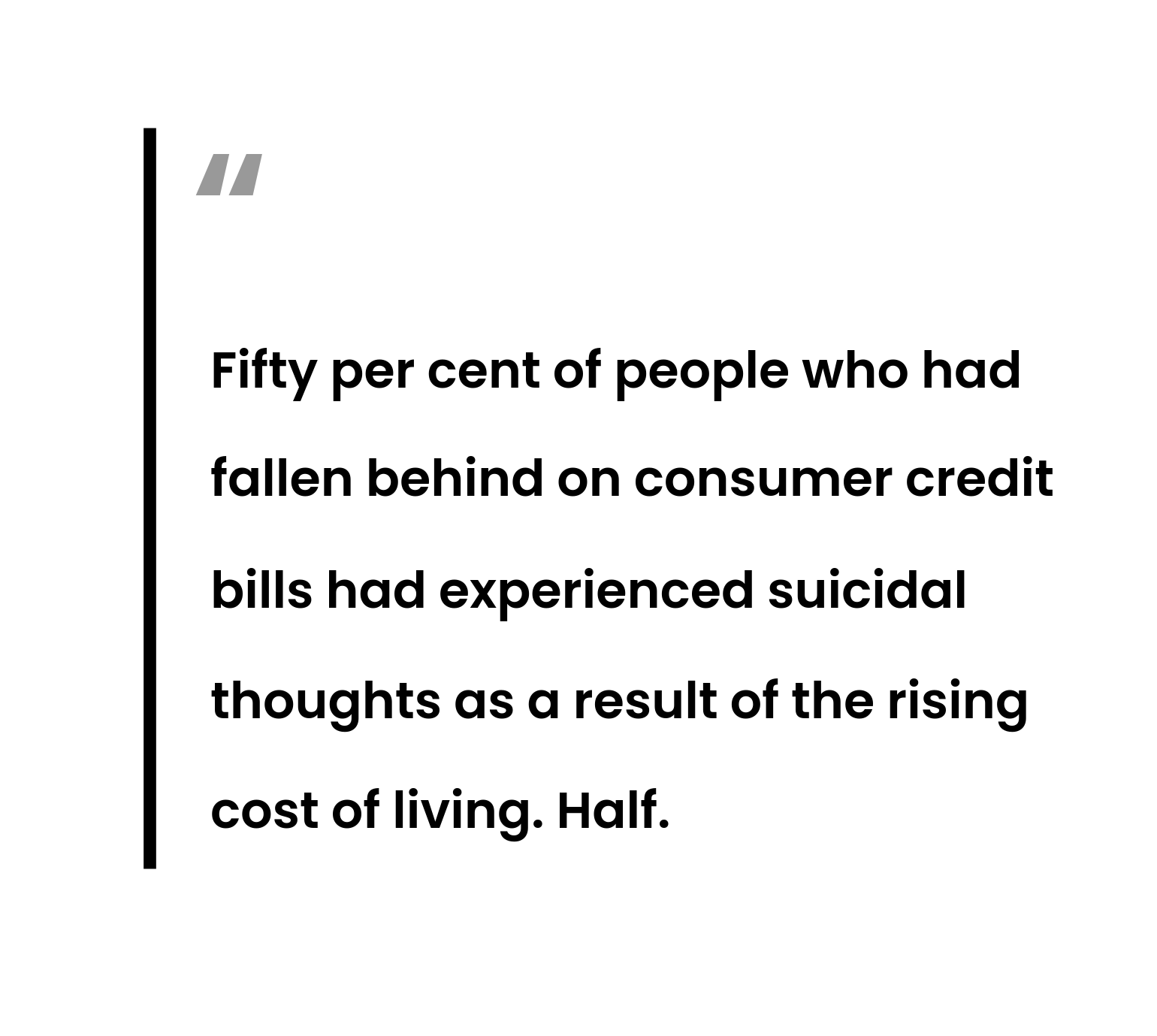
The Money and Mental Health Policy Institute quantified the extreme end of this. In their "Debts and Despair" research, they found that 50% of people who had fallen behind on consumer credit bills had experienced suicidal thoughts or feelings in the previous twenty months as a result of the rising cost of living. Half. This is not a statistic about long-term poverty or chronic mental illness. It is about people who missed a credit card payment or fell behind on a personal loan during an inflationary crisis, and whose shame became so overwhelming that they thought about ending their lives.5
Twenty-four per cent of those behind on payments were being contacted by their creditors every one to two days. Nearly half said they felt harassed by the volume of contact.6 The creditor communications, presumably intended to prompt repayment, were landing on people already in a shame spiral, people who were avoiding all engagement with their finances, people for whom each new letter or text message confirmed what they already believed: that they had failed, and that everyone knew.
You're not just broke. You're broken.
The distinction between shame and guilt, which psychologists draw carefully, is worth understanding because it changes what kind of help works. Guilt-driven people try to fix things: they call the creditor, they make a plan, they seek advice. Shame-driven people hide. They don't open the letters. They delete the voicemails. They tell their partner everything is fine. The British cultural environment, with its emphasis on financial competence as a marker of character, pushes people toward shame rather than guilt. When your sense of yourself as a capable adult is tied to your ability to manage money, and you can't manage money, the threat isn't just financial. It's existential. You're not just broke. You're broken.
This helps explain a pattern that debt advisers describe repeatedly: the phone call comes not at the first sign of trouble, but at the point of crisis. Not when the first payment is missed, but when the bailiff's letter arrives. Not when the debt starts growing, but when it has become unmanageable. The shame delays help-seeking by months or years, and in that gap, manageable problems become unmanageable ones. StepChange found that more than half their clients had waited over a year. By the time they called, the situation had often deteriorated to a point where the options were fewer and the damage harder to reverse.
The last taboo
In 2019, Lloyds Banking Group commissioned a survey that produced a finding which surprised almost nobody who lives in Britain but which is worth stating precisely because precision makes it harder to dismiss. Fifty per cent of British adults considered discussing personal finances taboo in everyday conversation. Money was rated more taboo than sex (42%), religion (26%), and politics (14%).7
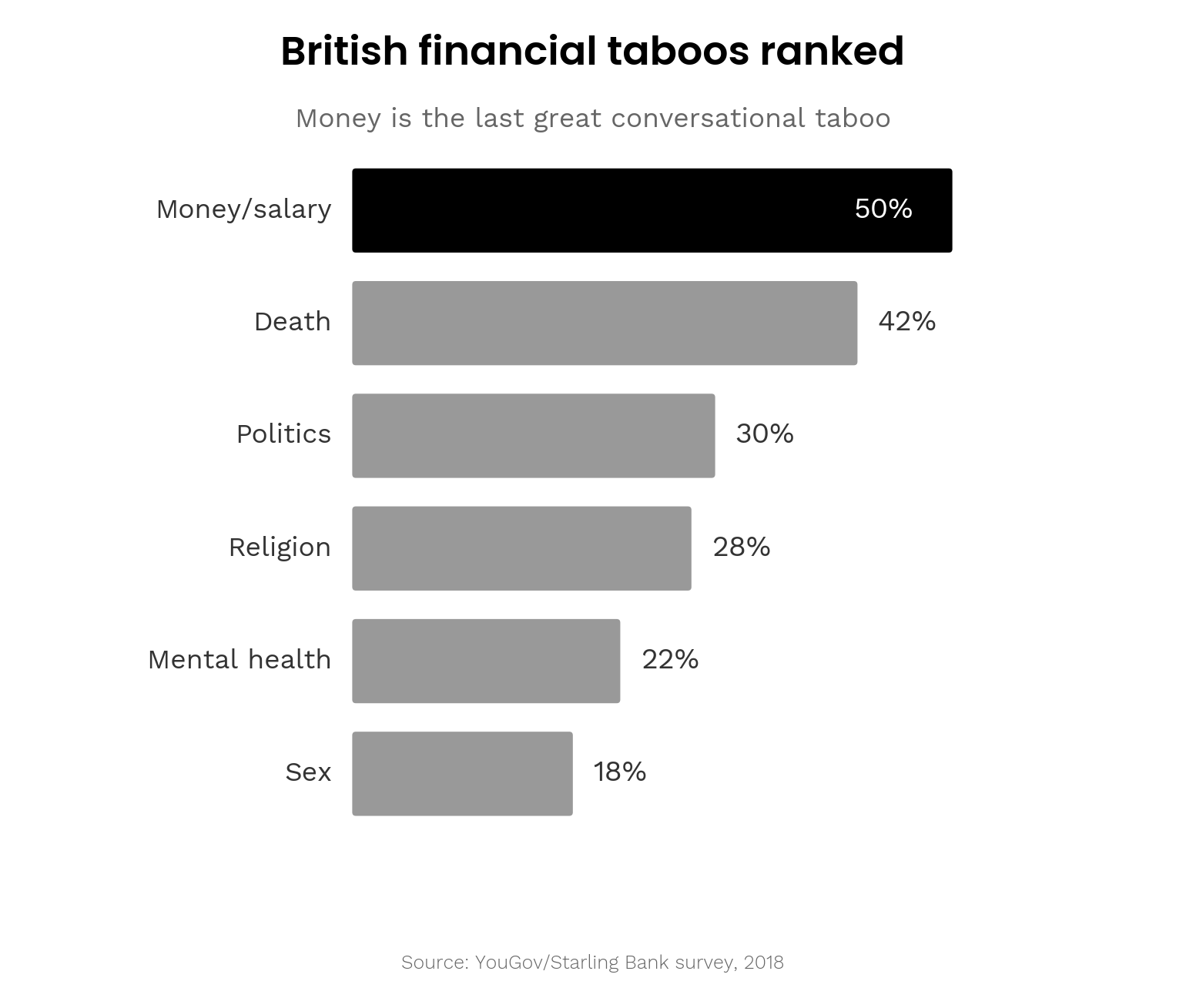
Think about that ordering for a moment. We live in a country where people will discuss their sexual preferences more readily than their salary. Where they will argue about God more comfortably than about their mortgage rate. Where they will have blazing rows about Brexit across the dinner table but cannot bring themselves to tell a friend they're struggling to pay the rent.
Twenty-five per cent of respondents said they had lied to family and friends about their finances. Ten per cent had lied to their partner about how much debt they carried.8 These are not small numbers. In a population of 67 million, ten per cent represents roughly 5.4 million adults lying to the person they share a bed with about how much they owe.
The question is why. Other countries have financial problems. Other countries have inequality and debt and financial anxiety. But the British version of money silence has a particular texture that seems to come from the intersection of class, propriety, and a specific kind of emotional restraint.
Mike Savage and colleagues, in the Great British Class Survey of 2013, found that class in Britain is not just about occupation or income. It is about economic, cultural, and social capital combined.9 The elite class had a mean household income of £89,000 and savings that were more than double any other class. But the class system also shapes what you're allowed to say about money. Old money doesn't discuss it because that would be vulgar. New money doesn't discuss it because that would reveal insecurity. The middle classes don't discuss it because they might discover they're not as comfortable as they appear. The working classes don't discuss it because admitting poverty triggers shame rather than support.
Everyone, in other words, has a class-based reason for silence. The mechanisms differ, but the outcome is the same: a society in which almost nobody tells the truth about their financial situation to the people around them. This creates what you might call an information vacuum. If you don't know how your peers are doing financially, you have no way to calibrate whether your own situation is normal, whether your anxiety is proportionate, or whether help is available and socially acceptable to seek.
The information vacuum has a specific cost during financial crises. When prices rise sharply, as they did in 2022, people need to make rapid adjustments to their spending. Those adjustments are easier if you know what others are doing. Are other families switching energy supplier? Are other parents buying school uniform from the cheaper shop? Are other homeowners calling their mortgage lender to negotiate? In a culture where these conversations happen openly, information spreads through social networks and people adjust faster. In a culture of silence, each household makes its adjustments alone, often later and less effectively, because they lack the social information that would speed up their response.
Money was simultaneously the organising principle of British society and the thing you were least supposed to mention.
The historical roots run deep. Victorian Britain developed an elaborate set of rules about money and status. The guineas system priced goods for the wealthy at 21 shillings rather than a round pound, creating a language of consumption that signalled class. "Old money" families treated any discussion of finances as irredeemably common. The phrase "trade" was used as an insult for generations, implying that anyone who earned money through commercial activity was socially inferior to those who inherited it. Money was simultaneously the organising principle of British society and the thing you were least supposed to mention.
The legacy of this persists in ways that are easy to miss. Job adverts in Britain still frequently describe salaries as "competitive" rather than stating a number. Estate agents describe properties as "offers in the region of" rather than naming a price. Salary discussions between colleagues remain, in many workplaces, practically forbidden by social convention even where they are legally protected. The Equality Act 2010 explicitly protects employees' right to discuss pay, but a legal right means little against a cultural norm that makes the conversation feel impossible. Try asking a British colleague what they earn and watch the physical discomfort cross their face.
The opacity has a direct economic cost. When people don't know what their colleagues earn, pay discrimination can persist unchallenged. When people don't know what their neighbours pay for utilities, they don't switch. When people don't know that their friends are also struggling, they don't pool information about where to find help. The silence is not just emotionally costly. It is economically inefficient. It prevents the flow of information that markets are supposed to rely on.
The concealment tax
Michael Moorhouse and colleagues, writing in the Journal of Marketing Research in 2023, studied what happens when people who are in debt anticipate being judged for it. Their findings give the silence a price tag.
About 20% of indebted people in their sample reported worrying moderately to extensively about being stigmatised because of their debt. One in five. That is a significant minority, and when you consider that the UK has roughly 10 million adults with problem debt at any given time, 20% of that figure represents two million people whose behaviour is being shaped by the anticipation of judgement. These people didn't just feel worse than other debtors. They behaved differently. They concealed their debt more aggressively: spending money they didn't have in social situations to avoid appearing poor, avoiding conversations about finances, and critically, avoiding seeking help. The concealment behaviours weren't just unproductive. They were actively destructive, increasing spending and reducing the likelihood of getting the advice that might have helped.10
Moorhouse ran a field experiment with a financial education company to test whether the social context of help-seeking mattered. It did. Debtors concerned about stigma who received community-based financial education (learning alongside peers in similar situations) paid off $4,370 more debt than a control group, compared to $3,531 more for those who received private instruction.11 They also reported a 15% increase in well-being, versus 8% for the private instruction group.12 Something about being with other people in the same situation reduced the shame enough to change behaviour.
This is a finding that StepChange and Citizens Advice and the other debt charities already knew intuitively, but rarely had the academic evidence to back up. The hardest part of their job is not the advice itself, which is often fairly straightforward: consolidate these debts, negotiate that payment plan, apply for this benefit. The hardest part is getting people through the door. The barrier is not information. It is the belief that needing help is a personal failure that must be hidden. The same StepChange data showed that 60% of their clients were in employment.13 These were not people who had dropped out of the economy. They were working, paying taxes, getting up every morning and going to their jobs. They just couldn't make the numbers work, and they couldn't tell anyone.
The pandemic made this worse in ways that were initially invisible. Gortz, McGowan, and Yeromonahos, writing in the Oxford Bulletin of Economics and Statistics in 2023, found that being furloughed increased the probability of late housing payments by 30% and late bill payments by 19%.1415 The aggregate incidence of financial distress rose by 3.38 percentage points.16 But furlough also came with an identity problem. Being furloughed meant admitting that your employer had decided they could function without you. For many people, particularly those in jobs that defined their sense of self, this was a shame trigger as well as a financial one. The government was paying 80% of your wages because your work wasn't needed. That is not an emotionally neutral message.
The result was a generation of furloughed workers who were financially stressed but culturally unable to say so. The dominant narrative of the furlough scheme was gratitude. "We should be thankful we have furlough." "At least we're not losing our jobs." The social pressure to frame furlough as a positive created a secondary silence: even within the general British silence about money, there was an additional layer of silence about the financial anxiety caused by a scheme everyone was supposed to be grateful for.
The cost of this concealment accumulates in ways that are difficult to measure but easy to see. When people hide their financial difficulties from partners, the partnership suffers. When they hide them from friends, the friendship becomes a performance. When they hide them from employers, they don't access workplace support that might help. When they hide them from GPs, the GP treats the insomnia and the anxiety without understanding the cause. The silence creates a series of broken feedback loops where the people who most need help are the ones least likely to reveal that they need it.
There's a gendered dimension too, though it doesn't always cut the way you might expect. Research consistently shows that women are more willing to discuss finances with friends and family than men, but also more likely to report financial anxiety. Men are more likely to conceal financial problems from their partners, particularly problems related to debt or gambling. The masculine ideal of the provider, though it has weakened over the past generation, still exerts enough cultural pressure that many men experience financial difficulty as an identity crisis. This may partly explain why men are significantly overrepresented in financial distress-related suicides.17 The shame isn't just about money. It's about what money represents in the construction of male identity.
The concealment tax, as I've come to think of it, is the accumulated cost of all this hiding. It is the interest that accumulates on debts that aren't addressed. The mental health damage of carrying a secret. The relationship strain of financial dishonesty. The economic inefficiency of a population that can't share information about prices, deals, and strategies because doing so would require admitting how much they earn and what they spend. It's invisible because it's made of absences: the conversations that don't happen, the help that isn't sought, the information that isn't shared.
The concealment tax is the bill for all this hiding, and it falls hardest on the people least able to pay it. In the next part: why Britain trusts a television presenter more than any qualified adviser, and what fifteen years of crisis have done to the silence.
Next in this series: The Martin Lewis question. If this was useful, subscribing gets you the rest of the series as it lands.
Perez-Truglia, R. (2020) Tax transparency and well-being. American Economic Review, 110(7).
Gladstone, J.J. et al. (2021) Shame and financial behaviour. Journal of Consumer Research.
Identical twin financial shame study. Source: Gladstone, J.J. et al. (2021) 'Financial shame spirals: How shame intensifies financial hardship', Organizational Behavior and Human Decision Processes, 167, pp. 42-56. Twin analysis within the same study.
StepChange (2024) Statistics Yearbook. 90% wished they had sought help sooner; more than half waited over a year before seeking debt advice.
Money and Mental Health Policy Institute (2023) Debts and Despair. 50% of those behind on consumer credit payments experienced suicidal thoughts in past 20 months.
Creditor contact frequency. Source: Money and Mental Health Policy Institute (2023) Debts and Despair. 24% contacted by creditors every 1-2 days; nearly 50% felt harassed.
Lloyds Banking Group (2019) 50% consider money taboo, more than sex (42%), religion (26%), politics (14%).
Financial dishonesty to family and partners. Source: Lloyds Banking Group (2019) The M-Word: Britain's Biggest Taboo. 25% lied about finances to family; 10% lied to partners about debt.
Savage, M. et al. (2013) A new model of social class. Sociology, 47(2), pp. 219-250.
Moorhouse, M. et al. (2023) Debt stigma and behavioural outcomes. Journal of Marketing Research.
Community vs private financial education. Source: Moorhouse, M. et al. (2023) 'Helping Those That Hide: Anticipated Stigmatization Drives Concealment and a Destructive Cycle of Debt', Journal of Marketing Research, 60(6), pp. 1135-1153. Community settings: USD 4,370 more debt paid off versus USD 3,531 in private instruction.
Moorhouse, M. et al. (2023) 'Helping Those That Hide', Journal of Marketing Research, 60(6), pp. 1135-1153. Community-based learning produced 15% wellbeing increase versus 8% with private instruction.
StepChange (2024) Statistics Yearbook. 60% of clients in employment.
Gortz, C., McGowan, C. & Yeromonahos, V. (2023) 'Furlough and Household Financial Distress during the COVID-19 Pandemic', Oxford Bulletin of Economics and Statistics, 85(6), pp. 1157-1184. 30% increase in probability of late housing payments.
Gortz, C. et al. (2023) 'Furlough and Household Financial Distress', Oxford Bulletin of Economics and Statistics, 85(6), pp. 1157-1184. 19% increase in probability of late bill payments.
Gortz, C. et al. (2023) Labour market dynamics during pandemics. Oxford Bulletin.
ONS (2023) Suicide statistics and coroner reports. Men consistently overrepresented in financial distress-related suicides in England and Wales.